JULES 0’
The European energy system is under tremendous pressure, facing an aging grid infrastructure, sky-high energy prices and hundreds of billions of euros of investments needed. But in the past few years, the stakes have gotten even higher. Energy has become a weapon that is being used against Europe, specifically by Russia. AI is set to surge electricity demand, just as the wider economy also electrifies. And new trade wars are making us rethink where we procure our energy equipment. On the positive side, a new generation of clean technologies is now ready to roll out, from superconductors to long duration energy storage, that might help us do this big upgrade in a more efficient way.
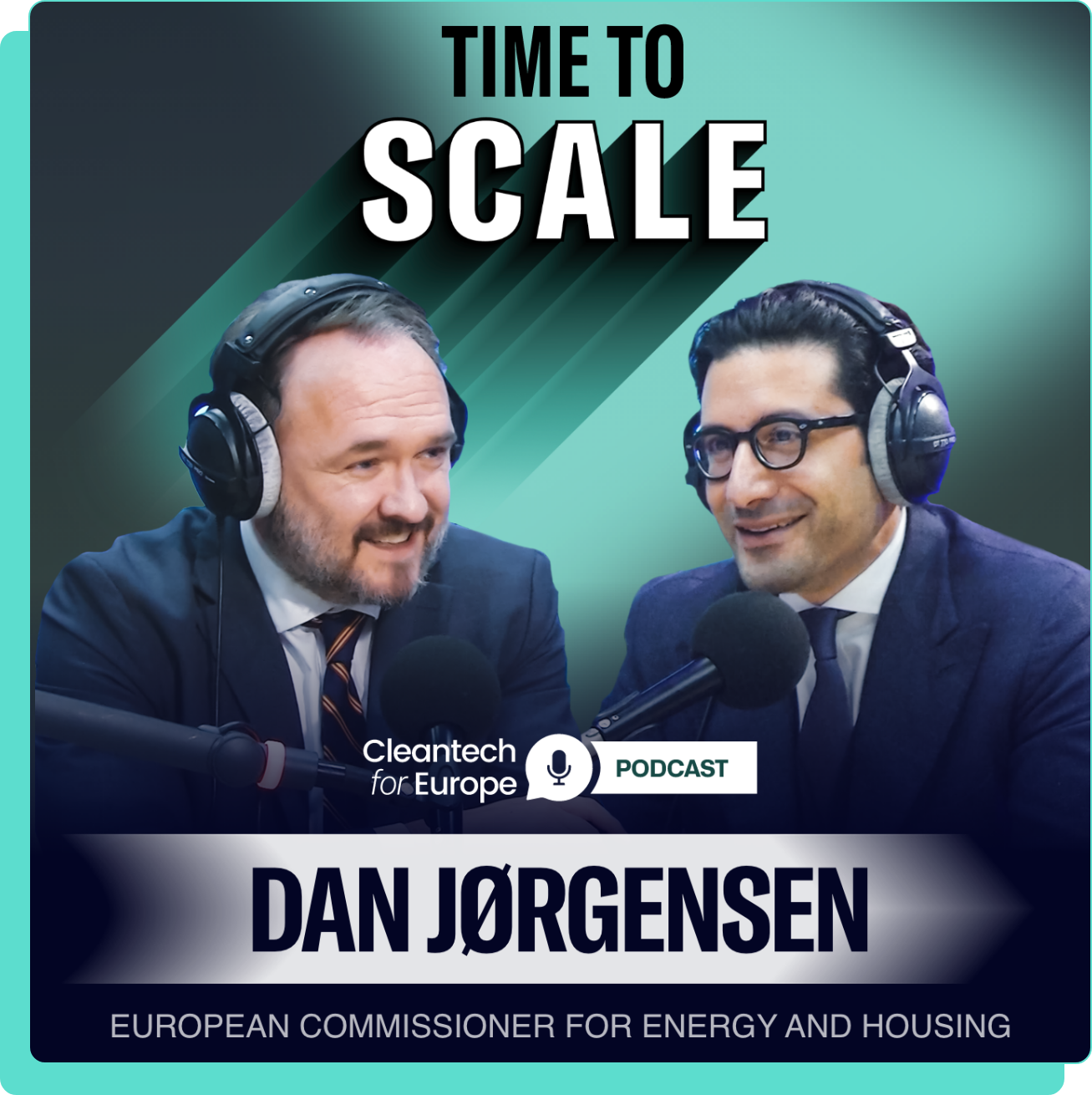
So the question for today is, can Europe face the energy gauntlet and build an energy system that enables the next generation of clean industry? And how can clean technologies contribute to this solution? I'm Jules Besnainou, and you're listening to Time to Scale, a podcast by Cleantech for Europe.
JULES
0’57 - Today, we are incredibly honored to have with us Dan Jørgensen, European Commissioner for Energy and Housing, hosting us here in the Berlaymont. Mr. Commissioner, hello. Hello. Great to have you here. Commissioner Jørgensen, you are responsible for energy and housing policy at the European Commission. You're also former Minister of Energy from Denmark. You're a social democrat. And from what I hear, you're also a passionate bird watcher.
DAN JØRGENSEN
01’22 - Sure, that's true, actually, yeah.
JULES
So for the listeners that might not know you yet, can you tell us a bit about your journey? What led you to where you are today?
DAN JØRGENSEN
01’30 - Well, actually, it did start with the birds, because when I was a kid, I really enjoyed going to the forest and watch birds. And that interest for nature got me into politics, because I really wanted to work on protecting our common nature, not only the birds, but certainly also the birds. And that, of course, then led to a much broader political agenda. And I was elected then to the European Parliament in... no, 2004, only 29 years old. And I served there for almost 10 years. And then I was called back to Denmark to serve as Minister for Food and Agriculture and Fisheries. After that, member of the Danish Parliament and Minister for Climate, Energy and Public Utilities, and later Minister for Development, Cooperation and Global Climate Policy. So that's the short version of my CV.
JULES
02’35 - And you've been here at the European Commission for one year, almost to the day. Can you tell us, you know, what you take away from this year?
DAN JØRGENSEN
02’42 - Well, it's been a hectic year, of course. We live in turbulent times, and energy is just there in the middle of almost all of the challenges that we face. Apart from that, of course, I also have the portfolio of housing, and Europe is in the middle of a housing crisis. So it's a tall order, and I have enough work cut out for me, I will say. But we've managed to make some very important decisions to lower our energy prices, which is absolutely essential for our competitiveness and also for the well-being of our citizens. We are fighting to combat climate change every day by decarbonizing our economy. That's also going fast in the right direction. And finally, of course, security is high on the agenda for a reason. We have a war on our continent. We need to help Ukraine as much as we can, whilst at the same time preserving our own security. And there, of course, energy is also an extremely important part of the puzzle.
JULES
03’46 Has your view on our energy system changed compared to when you were a minister in a member state?
DAN JØRGENSEN
03’51 - Not fundamentally. I've worked with these issues also since I was a member of the European Parliament, so for more than 20 years now. And I will say probably what has nuanced the discussion is the fact that security has always been a part of it. But now security is at the top of the agenda. So it's still actually the same three things that we've been discussing almost forever, I feel like saying, but at least a decade or two, which is decarbonization to fight climate change, lowering the prices to help our industry and citizens, and securing our independence for security reasons. These are the three major challenges and opportunities that we face and that we have. And of course, security is higher on the agenda now than it's ever been before. And that's probably the biggest change, if I were to point at one thing, single thing. Yeah.
JULES
04’56 - So let's get into this big energy challenge, right? In Europe, we have very little fossil fuels. We have an aging grid. We have war in Ukraine, you talked about it, rising demand for electricity and trade tensions with China and the US.Do you see any bright spots in the European energy system? Any points for hope?
DAN JØRGENSEN
05’14 - Sure. No, I agree with that analysis. And when you present it like that, obviously, we are in a serious situation. But you could have also started a different way. You could have said last year, we broke all records in deployment of new renewables with 78 gigawatts of newly deployed solar and wind primarily. This year, we will break it again. It'll be 89 and next year, it'll be even higher. Last year, we produced more energy, more electricity from solar energy than we did from coal. We are on track on meeting our incredibly ambitious target of 42.5% renewables in 2030. We've just adopted a new plan to reduce our emissions or a new target to reduce our emissions by 90% in 2040. So a lot of things are going in the right direction. I will say, though, that no time to rest on the laurels. On the contrary, we do need to make some both hard and decisive decisions right now if we are to keep up this development. The transition will not happen by itself. It needs political will and political actions.
JULES
06’29 - So we're here at the end of November. In a couple of weeks, you're going to present a series of measures, including a Grid Package. Could you tell us a bit about what is the main challenge you see and how do you plan to solve it?
DAN JØRGENSEN
06’41 - Yes, so the physical infrastructure of our energy system is extremely important. And on one hand, again, there's a lot of positive things to say. We're better connected as a continent and our countries in between than probably any other continent on the planet. So had it not been for the European Energy Union, we would have paid a lot more for our energy and it would have been much more difficult to decarbonize and we would have been much more vulnerable. ESA has estimated that we save more than 30 billion a year euro on being as connected as we are. So that's the good news. The bad news is that let's compare that to the transport sector. Let's say that we needed 200. This is just an arbitrary number, but let's say for argument's sake that we needed 200 roads to connect Europe. Then the situation and the analogy would be that we have the need for 200 roads, but we only have 100 and we only allow cars to drive on 50 of them.
07’52 - That's the situation in the energy system. So we need to utilize the grids that we already have, the infrastructure that we already have much better, but we also need to double more or less the actual size of what we have. So the number of cables, the number of pipes, the number of interconnectors. So we are working hard on that and in a few weeks I will present a plan to demonstrate how we will do it.
JULES
08’20 - The country that I know best is France and it's one of the big political blockers of more interconnections in Europe. What's your view? You've been obviously a member state minister. You know that these topics of interconnections are super hard. How do we solve this puzzle?
DAN JØRGENSEN
08’35 - Well, we need better European planning. Right now it's bottom-up approaches. There's a lot of positive things to be said about that from a democratic perspective. On the other hand, it's also very clear that if we don't start planning more on a central level, then we will not do this fast enough and we will not do it in a rational way. You could also put it like this. What are the odds that if we let member states get the idea, negotiate with their neighbors, hope that there's not an election that interferes with that, find the funding, make the negotiations in a way that everybody's satisfied and that happens then 250 places in Europe and then it all adds up being the most rational system that you can imagine. Probably that's not very realistic. So what I aim to do is turn it around and say, okay, we listen to the experts, we see what the analysis shows us is needed and then we from the European Union plan this and we show how the most rational energy system would look if we want to decarbonize, if we want lower prices, if we want to be independent. 09’56 - And then of course at the end of the day, it's up to member states whether or not they want to join. I'm not going to force any member states and even if I wanted to, I couldn't to have interconnected projects for instance. But I do think that if we do this the right way and certainly also if we are able to provide some funding to help sweeten the deal, then many countries will jump at this opportunity and that is why planning will be a very big part of the plan that I'll present. 10’22 - Also permitting, huge problem now that it takes way too long to get permits for making new renewable energy but also for building the grid that we need and that needs to be fundamentally changed and finally cost sharing. I mean, how do we then share the costs among countries that is up to negotiation every time and oftentimes it's the most difficult thing to agree on in the end, so we need more European guidance there.
JULES
10’52 - But it starts from central, almost open modeling, right? Like central planning of what needs to happen in an interconnected way. Maybe let's turn to clean technologies and their role in solving part of this challenge. We now have technologies like, you know, superconductors like HVDC cables with Siemens Energy in Europe, we have more and more long-duration energy storage with companies like Energy Dome, demand flexibility with companies like Simpower. What do you see as the role of these kind of innovative technologies that are very quickly getting to market in solving part of this challenge?
DAN JØRGENSEN
11’23 - I think that a lot of interesting things are happening these years and no doubt technology will help us solve many of the challenges that seem very, very difficult for us today. Look at storage for instance. I mean, even just five years ago when I served as Minister for Energy in Denmark and had the responsibility for planning our energy system, I can honestly say that even though most people will consider Denmark to be one of the countries that are doing the most in actually making a green transition happen fast, we didn't really have storage as that integrated part of our planning. Why? Because the possibilities were not really there. Battery technology not ready yet, not up in scale and down in price. The storage part of the hydrogen equation not really there in scale yet, but still isn't. But, you know, there's so many of these technologies that are developing day by day and it's difficult to project which ones will then be the major part of the solution. 12’30 - But what we do know is that with the help of digitalization and AI, with the help of new storage technology, especially batteries, but also others, with the more efficient use of cables and new types of cables, with new technology to help us become more efficient in the way that we use the energy, not only the way we produce it and transmit it, but also the way that we use it, we're really on a track towards something that can end up being a very, very rational and affordable decarbonized energy system that will then also have the very, very important benefit that we will become independent of all of the fossil energy that we import every year. It's more than 400 billion euros in a bad year. So that's something that really means something for our economies.
JULES
13’38 - But as you say, the change in reality has been, you now have almost two levels of technology, right? There's a level of technology that we know is proven, is ready to be deployed, you know, HVDC cables, long-duration energy storage, demand response. That wasn't necessarily the case 10 years ago. It is the case now, right? And then you've got the next generation that's also preparing around AI and much more that could be deployed. I guess, are you thinking, well, the proven technologies, let's start to deploy them at scale in this kind of general planning system. How do you see this kind of pipeline almost?
DAN JØRGENSEN
14’12 - Yeah, so we need to do everything at once. That's, of course, the difficult part. But there's simply just no way around it. We do need to ramp up our production of renewables. We need to ramp up our physical infrastructure, the grids. We need to get the AI and more simple digitalization tools out there working as soon as we can. So there will be an element of learning by doing. But I'll also say from the experience I have also as a policymaker in national politics that sometimes that's what it takes. I mean, if nobody's willing to take the first moves, if everybody's leaning back and waiting for somebody else to put technology on the market because it's a little bit expensive being the first ones, then things will not happen. In hydrogen, for instance, we have the problem right now that's comparable to what comes first, the hen or the egg, right? Because the producers say, well, we're not ready to ramp up our production before we know that there's actually a demand. And the demand side says, well, we cannot really transform our production until we know that we have the supply. So how do we solve this problem?
JULES
15’37 - This is a very good example. If I take the Renewable Energy Directive, for instance, it clearly set a first lead market for hydrogen in the case of refineries, right? Where you're starting to see projects going to FID in Europe, electrolyzers being manufactured on the continent. I guess, what's the equivalent for grids? Will we get some kind of innovation strategy, some kind of, at least like we had in the red as well, percentage of innovative technologies being deployed as part of a wider grid strategy?
DAN JØRGENSEN
16’07 - I think there's a huge potential for European companies here. And I'm not only talking high tech and new innovative technologies, although we certainly need them. I'm also actually just talking about more simple stuff. Whether it's how to produce cables, whether it's how to deploy them, whether it's how to find the most efficient ways of making the supply chain work and deliver the way you want. All of these things, I think European companies are well situated to deliver on. I will not conceal the fact that I can also sometimes be a little bit worried that we risk replacing one dependency with another, because we are struggling to get rid of our dependency on first and foremost Russian energy, of course. But actually, on a more broad level, we don't want to be dependent on anybody. 17’17 - So a part of that, maybe the most important part of that solution is more renewable energy. But the renewable energy technology, especially with regards to the rare minerals that it needs, are not to a large extent in our own hands in Europe. So we need to have very clear policies on how to make sure that we in the future produce more of our own technology and that we're not dependent on any one country, so that we diversify at least what it is that we cannot produce ourselves.
JULES
17’55 - You point almost squarely to the trade-off between trying to have an energy system where prices get as low as possible for consumers and industrials, and on the other hand, building supply chains here in Europe, making more of this equipment in Europe that might be a bit more expensive, at least at the start, while we get economies of scale. How do you see this trade-off?
DAN JØRGENSEN
18’16 - No, but that is a very real challenge. There's a reason why we in Europe buy the technology elsewhere. Part of the reason is that we don't have the production capacity yet. I hope that we will get there. And then of course, there's a very complicated analysis behind that that can explain why it is that we don't have these productions in Europe, and it's different from sector to sector and technology to technology. But overall, there are some problems that we know we do have to tackle. One of them is actually, as a paradox, the fact that we have quite expensive production processes, also because of the high energy prices. So we also need to lower the energy prices to make the production of energy technology cheaper. 19’15 - So that's just one aspect of this, and there's of course many others. So yeah, we need a holistic approach. That's also why this is not just something that I deal with in the Commission. It's really something that many of my colleagues are also struggling with and fighting for every day. So you'll see quite a wide range of Commissioners being engaged in this in the year to come.
JULES
19’45 - Okay, maybe one final question on coming back to innovation. Our community is, you know, cleantech innovators, startups, scale-ups, they're looking to bring these technologies to market. Even in the current context with what's happening with Trump in the US, and walking back on a lot of their policies, some companies still report to us that they still get 10 times, you know, the project pipeline in the US than they get in Europe, that investments are still much, much faster over there. How do we build a, you know, a policy environment, but more broadly an investment environment in Europe that keeps these companies here?
DAN JØRGENSEN
20’22 - Okay, maybe let me just start with one point. It's not actually a bad thing that European companies do business in the US. That's a good thing.
JULES
If they keep some presence here.
DAN JØRGENSEN
20’32 - No, no, no, no, of course. But we do want companies that are global and that can also... Yeah, but we don't disagree on that. It's just a point that's sometimes forgotten. Having said that, I know why you asked the question and why you phrase it the way you do, because there's also some competition in this, of course. I certainly agree with that. And we need to do more to facilitate these investments in Europe. I do think that the fact that the American administration has the policies that they do vis-a-vis renewables, I do not think it's good for the planet. I acknowledge that that's their prerogative, they can do what they want. It will have the effect that a lot of investors out there on the global markets that want to invest in clean and green tech will look for new markets. So that's also a chance for us. So even though we would have preferred if that was not the case, that is the way it is now. So let's exploit that as best we can.
21’42 - We need to do a lot of the things that I've mentioned earlier, faster. So get the energy prices down. That's also important. Make sure that we have the physical infrastructure that's necessary. So the grids plan is important here also. Next year I'll be presenting also an electrification plan. I'll be presenting policies on digitalization and AI, heating and cooling, small modular reactors, geothermal, just to mention a few of the things that we have in the pipeline. So we are not leaning back and letting things happen on their own. We are really trying to actively make policy decisions that will draw these investments to Europe. I also hope and think that there's somewhat of a catch-up effect often in these types of policy issues, because I mentioned earlier the problem with hydrogen, that the producers and the demanders are not exactly on the same page always. When that happens, when that's aligned, then things can go very, very fast. And we've seen, just to give you another example, we've seen how fast it can move in batteries.
23’06 - When a new technology is ready for the market, it can actually go quite fast. But of course we as policy makers, and that may be one of the weaknesses that we have in Europe, are not always good enough at exploiting that, because we have pretty long procedures. It's good that we have a checks and balances system in Europe, because we are 27 different countries and it's important that everybody's heard. But it does have the disadvantage that we really act slow. So let me give you one example of that. We want to get rid of Russian gas and now we will. But we should have done this a long time ago. Now I proposed six months ago a prohibition so that what we will do is we will ban the import of Russian gas. I'm extremely pleased that it seems like that that will gather support and that we will have very soon an agreement between the co-legislators.
24’09 - And this is a success and everybody is saying that's incredibly fast work. But friends, how can it be a success that it only takes us half a year to make a decision that we should have made a long time ago? And again, I'm not criticizing anybody. Of course, we're just following rules and procedures and it's also important to listen. It's a democratic process. I'm just saying that we need to be very aware that in a turbulent world where we have an American president that can sign decrees as he wishes, where we have an aggressor in the East that doesn't have to go through a long democratic process when he makes decisions on attacking our friends. We really do need to speed up these processes.
JULES
24’57 - Fair enough. Mr. Commissioner, big thanks for hosting us today. Good luck for all these new legislations coming up, especially we'll be looking at the great package. Thank you for hosting us here in the Berlaymont. And thank you all for tuning in to Time to Scale, the podcast by Clean Tech for Europe. If you enjoyed this episode, subscribe, rate, review it, share with a friend and we'll link to Commissioner Jørgensen’s social media in the episode notes. See you soon. Thank you so much.