Cleantech for Europe’s Policy Update - December edition
December 11, 2025

Yesterday, the European Commission presented its Grids Package, aimed at tackling bottlenecks and moving toward a more interconnected European electricity and hydrogen network. The Package focuses on EU-level planning, faster project delivery, investment mobilisation, and grid security and resilience.
The Package aims to strengthen EU-level coordination of cross-border energy planning. The Commission intends to develop a central EU energy scenario within two years to guide investments and optimise existing networks. While the intention to provide a single reference for planning is clear, the two-year timeline risks delaying urgently needed decisions, and the Package offers limited clarity on how planning will accelerate the deployment of innovative grid technologies across Europe.
The Package proposes an EU framework to simplify and accelerate permitting for grid infrastructure, renewables, storage, and recharging stations. Renewable projects above 10MW would be required to share benefits with local communities. These measures could help reduce project delays, but the Package does not yet provide concrete mechanisms to ensure timely execution.
With EUR 1.2 trillion needed for electricity and hydrogen grids by 2040, the Package highlights future-proof grid fees, fair cost-sharing for cross-border projects, and mechanisms to attract private investment, including EIB support. However, it lacks a clear vision for supporting European manufacturing of critical grid technologies, which could limit strategic autonomy and the ability to scale up deployment.
The package integrates physical and cyber security into planning to ensure resilience by design. Upgrades to existing infrastructure would be eligible for CEF financing
Eight priority corridors would receive targeted support to remove bottlenecks, integrate renewables, reduce fossil fuel dependence, and accelerate REPowerEU objectives.
While the Package marks a step toward a more coordinated European energy system, gaps remain on industrial support, particularly to innovative grid technologies manufacturing, and the speed of infrastructure planning and execution, with two years before infrastructure needs assessment, raising questions about its effectiveness in rapidly addressing current bottlenecks.
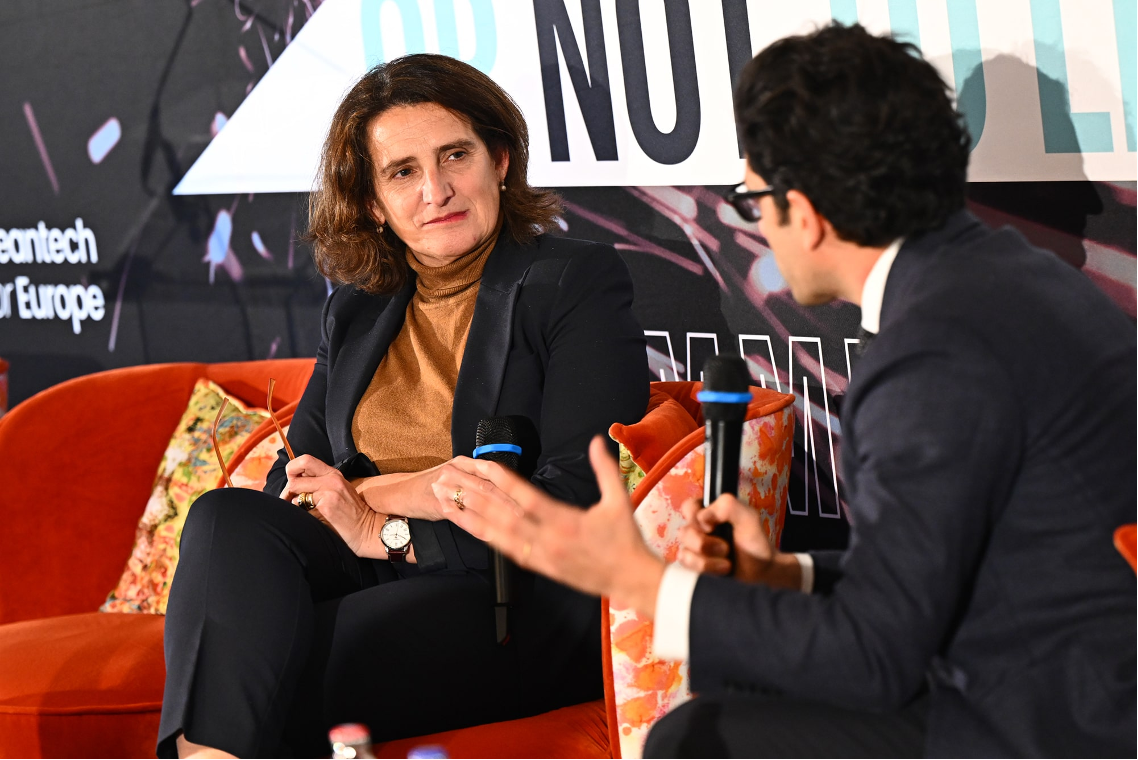
On December 3rd, the annual Cleantech for Europe Summit returned to Brussels for its fifth edition. At the one-year mark of the new European Commission's mandate, the event brought together the highest levels of policy, cleantech and investment leaders to discuss a critical question for clean industry in Europe: To Lead or Not To Lead?
In her keynote, Executive Vice-President Teresa Ribera highlighted the importance of keeping cleantech manufacturing in Europe and laying the foundation for EU leadership.
“Clean technologies are now at the heart of Europe's competitiveness, security, climate goals, geopolitics and our ability to face threats and challenges. And Europe can lead the global cleantech race. We have the research, knowledge, skills and companies to do it. We now need to keep and grow our cleantech manufacturing capacity.”
Learn more about the Summit in our press release or watch the full recording of the event.
This week, the European Commission was due to unveil its Industrial Accelerator Act (IAA), now delayed to January 28th due to a pushback from a caucus of nine EU countries led by the Czech Republic and including Estonia, Finland, Ireland, Latvia, Malta, Portugal, Slovakia and Sweden. They have raised concerns that protecting certain sectors could disadvantage Europe by restricting openness to global markets.
In times of high energy costs, fragmented markets and fierce foreign competition, Europe cannot afford hesitation on industrial policy. The IAA is a key opportunity to adopt a strong cleantech ‘Made in Europe’ strategy and change the course towards clean industrial leadership. Learn more in our IAA paper or by watching the recording of our ‘Made in Europe’ panel at Cleantech for Europe Summit (starts at 4:44:16).
On 4 December, the European Commission launched the 2025 Innovation Fund calls, with €5.2 billion available across three windows: the Net-Zero Technologies call (€2.9bn), a first EU-wide auction for industrial process heat (€1bn) under the Industrial Decarbonisation Bank, and a third ‘European Hydrogen Bank’ auction (€1.3bn). Deadlines run from February to April 2026, with dedicated info days and helpdesks on the EU Funding & Tenders portal.
These calls land against a challenging track record: since 2021, €7.1bn has been awarded but in fact less than 5% disbursed, while the considerable application costs weigh disproportionately on scale-ups. Ahead of next year’s EU ETS review, we are collecting structured feedback on how the Fund can better serve the scaling up of clean industry in Europe.
On February 9th, the final online conference of the REALIZE project will take place. REALIZE is an EU-funded project with the goal to present new renewable energy generation technologies to the EU Innovation Fund through proposals resulting from completed Horizon projects in Renewable Energy Sources. Our Director Victor van Hoorn will participate in a panel discussion on whether the European Competitiveness Fund will deliver for innovative renewable energy start-ups and scale-ups. You can register for the conference here.
On 3 December, the Commission released its new Economic Security Communication, signalling a shift from a reactive posture to a more strategic and coordinated geoeconomic approach. The document broadens the EU’s economic-security perimeter, identifies six priority high-risk areas (from critical technologies to defence and space), and reinforces supply-chain resilience through proposed common economic security standards. Governance is central: the Commission will create an Economic Security Information Hub, encourage Member States to appoint National Economic Security Advisors, and establish a trusted adviser group drawn from industry to improve real-time intelligence and scenario planning.
The Communication expands the EU’s economic security toolbox, but still operates as a strategic framework rather than a fully fledged doctrine with concrete, operational measures. Its impact will hinge on Member State political will and execution. Crucially, this broader paradigm sets the stage for the Commission’s first flagship test case: RESourceEU (see our update on that below). It is sector-specific initiatives like RESourceEU that will determine whether economic security becomes operational rather than aspirational – and its model could be replicated across other critical clean-industrial supply chains.
On 3 December, the European Commission adopted the RESourceEU Action Plan to accelerate and amplify efforts to secure the EU’s supply of critical raw materials. The package introduces joint purchasing, coordinated stockpiling, export restrictions on key scrap streams, streamlined permitting for strategic projects, and up to €3 billion in EU funding in 2026 – complemented by European Investment Bank and Member State financial support for Strategic Projects. A new European Critical Raw Materials Centre will provide market intelligence, steer and finance strategic projects with public-private partners, and act as a portfolio manager for diversified and resilient supply chains.
RESourceEU is a notable shift toward a real industrial policy for CRMs, but it has an apparent funding mismatch. Most CRMS projects are looking for equity capital, price floors or hedges (1 or 2-way contracts for differences). But most funding committments from the EU and EIB can only be deployed via grants, fixed-premium support or loans. The plan does not fundamentally shift the bankability of most projects. As the US stacks industrial policy and financing tools around specific deals at speed, Europe has not shown the same boldness. Delivery – not design – will determine whether RESourceEU meaningfully reduces Europe’s dependencies.
The Commission’s new Early Movers Coalition for e-SAF is gaining momentum. Austria, Portugal, the Netherlands, France, Spain, Finland, Germany and Luxembourg will work with the Commission to launch a pilot double-sided auction in 2026. If participating countries deliver funding, the scheme could support one to two commercial-scale plants over 10–15 years. It won’t meet all 2030 ReFuelEU volumes, but it is the early market-making step Europe needs to kick-start made-in-Europe e-SAF production and provide a blueprint for an EU-wide revenue-certainty mechanism.
Vulcan Energy secured a €2.2 billion financing package to fully fund Phase One of its Lionheart project in Germany — enabling the Board to take a positive Final Investment Decision (FID). Phase One combines geothermal renewable energy with domestic lithium production, targeting 24,000 t/year of lithium hydroxide for Europe’s battery industry. The package includes €1.185 billion in senior debt from a syndicate led by the European Investment Bank, alongside German government grants and strategic equity. Construction will begin in the coming days.
Skeleton inaugurates €220M Leipzig SuperFactory: Skeleton Technologies has opened its €220M Leipzig SuperFactory, creating 420 jobs and scaling Europe’s capacity in mission-critical energy storage. The world’s leading supercapacitor manufacturer equips grids, defence systems, AI data centres, and heavy industry with ultra-reliable power based on its Curved Graphene technology.
Einride goes public via SPAC merger in the U.S.: Swedish autonomous trucking pioneer Einride went public in the U.S. through a SPAC merger with Legato Merger Corp III in November 2025, valuing the company at $1.8B. The listing will fund growth in self-driving logistics, building on $65M in contracted recurring revenue and $800M in scaling plans.
AFYREN raises €23M to expand low-carbon production: France-based AFYREN secured €23 million through a share capital increase, welcoming Kemin Industries as a new reference shareholder (€20M) alongside €3M from Bpifrance Large Venture. Funds will consolidate operations and expand AFYREN NEOXY production, strengthening its position as a leading European manufacturer of low-carbon, biobased solutions.
Reverion and Frontier advance biogas carbon removal: German company Reverion, in partnership with Frontier, is scaling a biogas-to-electricity pathway that captures carbon from both methane and CO₂. Frontier buyers will fund $41M to remove 96,000 tons of CO₂ between 2027-2030, enabling decentralized clean electricity and near-term carbon removal at scale.
Future Energy Ventures Fund II closes €235M: Germany-based VC Future Energy Ventures Fund II closed in December 2025 at €235M. Backed by global partners, FEV invests in Series A and B startups delivering AI-driven, software-based solutions for grid efficiency, demand flexibility, and decarbonisation, accelerating Europe’s transition to an independent, resilient energy future.
XAnge closes €200M for early-stage tech fund: France-based VC XAnge closed €200M first round for its 5th early-stage fund, backing AI, deeptech, and sustainable innovation across Europe. Supported by EIF, Siparex, Bpifrance, and CNP Assurances, the fund targets €1-15M investments, expanding beyond France, Germany, and Belgium into Spain, Italy, Benelux, and the Nordics in 2025.
· Scaling Up Transition Finance – Analysis – IEA
· Venture & growth capital in Europe–mapping pension funds’ attitudes
· Renewables 2025 – IEA Report
Time To Scale: A new Podcast by Cleantech for Europe – Listen to the latest two episodes, featuring Dan Jørgensen, European Commissioner of Energy and Housing, and Lídia Pereira, MEP and Vice-President of EPP Group!


