JULES
0’ - On June 6, 2024, Europeans across the continent went to the polls to elect a new European Parliament. Europe's conservative party, the European People's Party or EPP, came first with close to 35 million votes, gaining one seat in the process while all other centrist parties lost seats and the far-right and far-left grew. It was clear in the EPP's campaign manifesto and in your doctrine in a way that decarbonisation and competitiveness go hand in hand. With climate protection seen really as a tool to drive innovation, and clean technologies are at the heart of this, the manifesto calls for a cleantech investment plan and for Europe to become a leader in the industries of tomorrow. But 18 months after these elections, war is still raging in Ukraine. We have a new trade war with the US and still very high energy prices hurting our industry. And just today, and I hope you'll tell us a bit more about this, here in the European Parliament a new climate law was passed at the same time as some corporate accountability was delayed. So the questions we have today are: can Europe still become a clean industrial leader and compete globally? What's the trade-off between protecting legacy industries and supporting new ones to grow? And how do European voters see these questions?
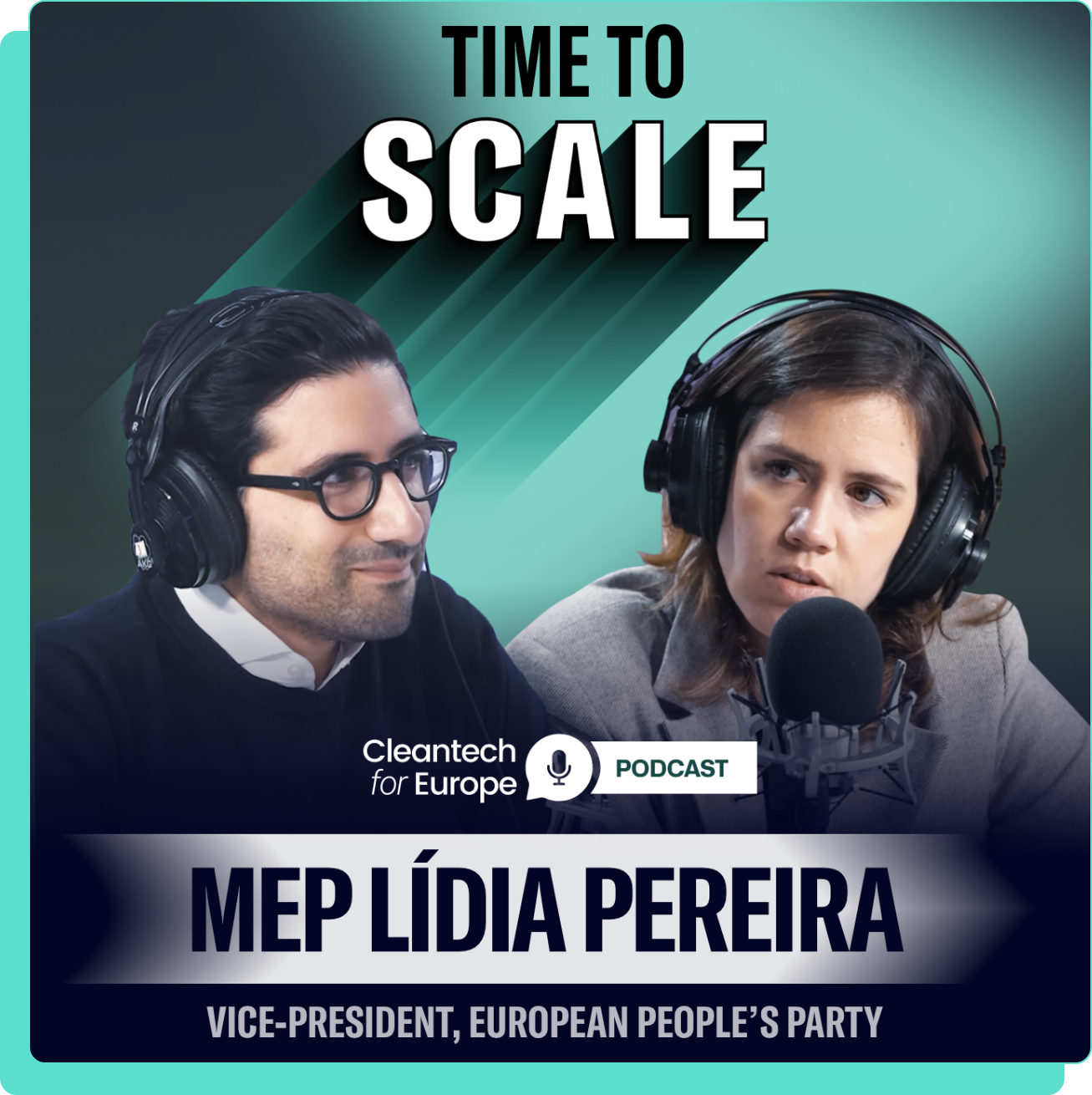
I'm Jules Besnainou, and you're listening to Time to Scale, a podcast by Cleantech for Europe.
JULES
1’23 - Today, we're super excited to speak to Lidia Pereira, a Portuguese member of the European Parliament and Vice-President of the European People's Party. Hello, Lidia.
Hello.
Lidia, you became president of the youth of the European People's Party at 26 and were elected member of the European Parliament just one year later. You're also one of the leading voices on clean technologies in the European Parliament as co-chair of the Cleantech Friendship Group. And you're receiving us today here in the European Parliament on a very special day. And I hope you'll tell us a bit more about this in the episode. I'd like to focus our conversation today on the current state of EU politics on cleantech and the risks and opportunities you see for Europe's climate and industrial leadership.
02’02 - But first, maybe let's give our audience the chance to get to know you a little bit better. Could you tell us, before we dive into the politics, about your personal journey? What led you to where you are today?
LÍDIA
2’13 - Well, I am from Coimbra, which is a mid-sized town in Portugal. I studied there and I went on Erasmus. And when I went to Prague for the exchange year, I understood that the international experience was a very valuable one. And so I did my master's degree as well abroad in the College of Europe. And it led me then to an internship in Luxembourg. I ended up staying in Luxembourg for another two and a half years, working for the financial sector in compliance and anti-money laundering. And then later on, Brussels as well in the private sector. And finally, I was always involved, even being abroad, I always kept my base, my hometown Coimbra, my family, my boyfriend, they are all there. And I always connected as well from a political perspective. So I was very much involved in the youth organization of my party. And I was, in the end of 2018, I was elected President of the youth of EPP. I mean, it was after some years as Vice-President and then as international secretary for the youth organisation. And on that occasion, there was a big buzz in Portugal. And at the time, the party leader, he invited me to be on the list. And it was an invitation that very rarely you can afford to say no to.
04’05 - For me, it was a challenge. I mean, professionally, I was very happy where I was. But obviously, I'm also in politics. And I always say that politics is to serve. We are in this with some sort of a mission. And I had the opportunity to deliver something for my community, for all Europeans at large. And that's how I came to the European Parliament in 2019. And it's been quite an adventure. And I can say that the first term was a little bit complicated because we were affected by the pandemic. And it was in an early stage of the beginning of the term. But in any case, it was in the last term that we led the foundations for being on the right side of history, the way I usually say it in terms of environment, in terms of economy, with a lot of challenges in front of us. That's true. And we haven't done everything in a good way. So there's things to be fixed. But that's how I am here. And I'm very proud of having this chance to serve the people of Europe.
JULES
5’26 - So you've obviously been very involved in your party from super early on. How did you choose it?
LÍDIA
5’30 - Well, it was at the local level. I only became a member, I was, I think, 21. And it was in a reaction at the time against the establishment. It was a socialist party in government. And then we had the difficult times of Troika. And I decided like, OK, I want to do better for the future generations. And so, I mean, I was politically more inclined to the center-right. And so it was a natural path. So I started at the local branch, contributing with ideas, with projects. But then the course of my career led me to have a wider international involvement. And that's how it started.
JULES
6’29 - So you ended up in the bigger family. Yes. So for anyone who follows you over the past few years, we've seen you go through several elections. Municipal races in Coimbra, some legislative races in Portugal, two European elections. What I'd love to hear from you is you talk to the voters every day or almost every week. What do you hear from them on this topic of climate competitiveness, cleantech? How do you connect this topic to what your voters care about?
LÍDIA
6’56 - I will say this because I think this is relevant for the political circumstances or the political context we are facing now. In 2019, we had a lot of public support on the streets. There were a lot of protests. There was the Fridays for Future. I participated in one of those protests in Porto in Portugal. And I can tell you that the reaction led the European Commission, the European institutions, to have a concrete proposal for it. And that's why at the beginning of the last term, in 2020, the president of the Commission, Ursula von der Leyen, she presented first the Green Deal and one year later the European Climate Law. And everything that unfolded after that, the Fit for 55 and the true legislative roadmap for decarbonization. So people were vocal. People wanted to be heard. And they were heard, especially the younger generations.
8’03 - And I think this is relevant to say. But today, we don't have the same public support on the streets, which doesn't mean that this is not relevant. Because then we look at the data from the surveys of the Eurobarometer, it's very clear that environment and climate change are still ranking in the top five of the European people's concerns. What do people say is that they are first and foremost concerned about the economic situation with their salaries, taxes and so on. But obviously, they also feel affected by climate change. I come from a country that is very much affected by climate change. The other day, I was even telling to my mother, like, I miss having, you know, better defined seasons.
8’56 - Like we are now in the fall, but sometimes we still have days like it looks like summer. It feels like summer. And so this is evident. People feel it. People from the south of Portugal, they feel the lack of water. This year was quite good in terms of, you know, rain, showers and so on. So we have some good reserves of water. But it is very frequent that we hear these sort of things. And the same goes with forest fires. So people do acknowledge that we have to do something. The big discussion is, should Europe take the burden solely alone? And then I would say no. And we need the other countries in the world, especially the biggest polluters in the world, to commit to mitigate.
9’54 - And in some occasions already just focusing as well on the adaptation. Because it's quite visible some countries, some cultures that are in danger because of the rising levels of the sea, the rising global temperature. So we really need to do something. But the difficulty here or the political difficulty is to combine both things. I've always defended that it is possible to combine economy and environment. They are not in opposition. They can work hand in hand. Mario Draghi said it in his report. And we have the technology and we have the capacity to deliver on these two fronts. Also because in Europe we don't have natural resources. So we need to find a different way of sourcing energy. And cleantech is here an important element.
JULES
10’54 - I want to point to this tension between the feeling that this is somehow a burden and that it needs to be shared globally. And the other notion that you just shared, which is actually it is an opportunity. It's an opportunity for economic leadership, for industrial leadership, for jobs, etc.
LÍDIA
For the economy of the future.
JULES
Exactly. And especially for Europe. And we also see China racing past us in a few of these sectors. So I guess what I'm interested in hearing from you, as you're really inside the party politics and the party machine, how is that tension politically playing out? Between those who think that this is mostly a burden and reporting requirements and those who think this is our economic future. How do we prepare for it?
LÍDIA
11’41 - I think we are still leading with some of the legacy from the previous term. That was not so successful in terms of convincing a wider group of politicians, of people that this is the way, this is what's going to define the next years in our economies in the world. And I'm saying this because I was in many negotiations where I alerted to that. We cannot squeeze our SMEs with reporting standards, with things that they cannot cope with. Because financially, we don't have the same structure as for example the one in the US. So we have to be realistic. And we also have to look at the numbers. I'm sorry but we are responsible for 6% of the global CO2 emissions. So it is fair to ask to the others to contribute. But I think politically this is the issue.
12’45 - There was a lot of ideology in dealing with a number of laws, legislation. And now what is happening is trying to fine tune. Because we are not touching on anything related to the ambition. The target for the climate neutrality in 2050, nobody is challenging that, everyone says it's there so we have to deliver. Now we just had today the approval of the intermediate target for 2040, which is also a good thing because it sheds light to the industries, to investors to know where Europe is going. And that we are going in the right direction. But there is... I feel... And this is also important to say publicly. I feel that there is sometimes less room for dialogue about these matters. Because suddenly the buzzword is competitiveness. But to me the buzzword was always competitiveness.
13’52 - Competitiveness, environment, economy. They all play together. And so the challenge is to have here a moderate approach that brings everyone on board. But unfortunately, and this is becoming more and more visible in the Parliament, there are some hidden agendas which they have only one priority. And that is to ruin the European project. And unfortunately this is true. And we have to navigate through this complexity. We have to foster agreements with the political forces that are actually committed to deliver as well on the European project. So it became more complicated than back in 2019, I would say.
JULES
14’37 - And I think today is a perfect example. With one vote being part of a centrist consensus. And another one not being so.
LÍDIA
But that's again... I'm sorry and I have a very good relationship with my colleagues from the S&D, Thomas, he's one of our co-chairs. But this resistance, it's like resistance, the mood that comes on several occasions from the left and particularly from the S&D. It is not constructive for the challenges we have in front of us. And what happened for example with the Omnibus, it is unfortunately illustrative of that.
JULES
15’16 - We'll have a droit de réponse on this. But maybe to say... I've seen simplification processes from the inside that go really well. I'm part of the CBAM expert group at the European Commission. And the simplification that was done there was totally common sense. Like we should do this for our businesses. I think the worries come when you start to, as you say, kind of reduce some of the ambitions like in the ETS and others.
LÍDIA
15’39 - Well, on that front, when we discussed the 2040 target, I'm also not very happy with the fact that we postponed the ETS for one year. But it was necessary for the basis of the compromise.
JULES
Maybe one more tension point that I'd like your opinion on. There's obviously a kind of free trade streak in the center-right that is very traditional in Europe, but also in the US everywhere. There's another streak these days that is more about protecting European industry, especially in sectors where we're a bit earlier. And we may need some of these protections. What's your take on this kind of tension?
LÍDIA
16’18 - I think free trade is still necessary. I think I'm not very much in favor of this overprotection mood. Because, I mean, in everything we have winners and losers. But I also acknowledge that Europe has to do it right. I mean, the pandemic exposed us on several dimensions. One of them was the vulnerability of being exposed to the Chinese market. I remember at the very beginning how difficult it was to get access to medical equipment, to masks. It was really, really complicated. Even medicines. So it is obvious that we have to diversify our chains of supply. And hence the trade deals, trade agreements are so important. So I'm very much in favor of global trade. It is also a way to influence the behavior of others to commit to the goals that we have set together, but with the driving force of the European Union.
17’33 - So on that front, I think it is important that we conclude quickly the Mercosur deal with South Africa, with India. And what is relevant here is that on the trade deal with Mercosur, the climate agenda or the commitment to the Paris Accord is there. So if everyone complies, that works. If not, then there are consequences. And that's actually something that comes, and it is fair to say that it comes from the President of the Commission. She's been very determined on that. And at the same time, it is relevant because we know that our transatlantic relationship, even if it remains very important and priority and historically determinant…
JULES
It's in a bit of a weird place.
LÍDIA
18’24 - It is, and it's not going to come back. I think there is, sometimes I hear some people that are speaking away that, well, you know, this is just a phase. No, it's not a phase.
Things have changed. Things have changed dramatically during the pandemic. And we still benefit for better reasons, for not so good reasons. But we are coping with the post-pandemic consequences that it had in our communities. So the same goes with international politics, and in particular geopolitics, that the traditional U.S.-EU relationship, I think, has evolved now to a different understanding. And we have to acknowledge that and we have to take action. And that's why I'm saying international trade is very relevant, and trade deals, it was never so more necessary to have this diversification.
JULES
19’22 - So I want to ask you about COP before we leave you, but maybe before we do that, any examples of clean technologies you've seen over the past few years that you find super exciting for Europe, for Portugal? Any specific opportunities?
LÍDIA
19’36 - Yeah, well, thanks to cleantech, I've been visiting a number of very good examples of entrepreneurship and companies that see the opportunity that the circumstances brings. And I'm actually very interested in the textile industry. We visited a couple, and how it connects as well to our previous conversation about the international trade and how things seem to be a little bit more going in this protective mode. So maybe circularity makes even more sense, and we can take advantage of the technology so companies like the fashion industry, they can trust the fibers they need for their clothes that remain stable. And that is one. Another, I think it's the carbon capture. It is something that's still in a very early stage of development, but I think with the right incentives and with the right investment, it will be possible to deliver. And not forgetting the... Sorry, I forgot. I remember the name of the company, Stegra.
JULES
Yeah, doing green steel in Sweden.
LÍDIA
21’07 - Doing green steel, exactly. And how important they became also being a player, even on the automotive industry. We know that we are struggling in Europe because our automotive industry did not make the necessary investments to cope with the challenges we have now, like electrification. But there is opportunities to use or to develop further technology in the current context, and that can also be beneficial for a very important industry as the automotive industry. So there's a lot of good examples, and I'm very fortunate to have the opportunity to meet some of those CEOs, entrepreneurs, and that there is still the driving force for the European way.
JULES
21’55 - Fantastic. Maybe just to wrap up, you're leading the European Parliament's delegation to COP30. I think you're going in a couple of days. What should the EU try to achieve at COP30?
LÍDIA
Well, the EU has been the leader in defining the climate agenda globally, and we go there again. The European Parliament has a very well-defined mandate. The initiative on the exotic forests is important. The fact that COP30 happens nearly at the gates of Amazonia, it's also important from a biodiversity conservation perspective. But I think it would be very important to understand where we stand when it comes to the nationally determined contributions. We have 2035 right in front of us. We have 2040, but 2035 is important. It's important to have this assessment globally. It is also important, and I have been saying this, to understand where China is going to position itself.
23’08 - I mean, China has been always hiding in the vest of a developing country. They recently abdicated, they gave in on their developing status in the World Trade Organization. And I'm wondering if it will have consequences in the climate financing and how China will define its position evolving eventually from developing country to developed country and then contribute on a mandatory basis as they have not been doing so. I'm saying this because not having the US at this conference, and even if I think it is bad because it is always better to have everyone represented, but Argentina is also not going. I believe that compared to my experience last year, China was already having a much more affirmative and assertive positioning geopolitically using climate change and environment. So I'm looking forward, I would like to see China stepping up the game and being responsible as I said.
24’09 - Many things, I think the most important thing is that there is again a renewed commitment with the strategies that are ongoing and that countries in the world can look at Europe and say, well, they managed to do it, so why we cannot do it? But obviously there has to be a big push from developed countries in such direction. And Brazil will obviously play a role, not only as a host but having the presidency and trying to affirm as well as a global player. They were recently in charge of the presidency of the G20, so they have a good relationship with some players in the world. Let's see what's going to happen, but I'm also optimistic.
JULES
25’23 - So you've worked with them in the lead-up to the COP, anything specific that you want to flag?
LÍDIA
25’29 - Well, they are obviously emerging as a country that is developing further and that really wants to convoke everyone to protect what is important for us, and in this case Amazonia. So that's why I referred to the Forest Fund, which is a relevant thing. It's very much referred to as the lung of the world. But I think it will be important the day after the commitment or the agreement is signed to then debrief on what were the achievements. I think as opposed to previous COPs, expectations are not as high. Yes, so usually there's this excitement of expectations that are very, very high. You're saying we might get positively surprised. Yes, so if we have moderate expectations, maybe we will achieve better. But I think what I'm expecting is a very determined role of Brazil in managing everyone around the table and making sure that we have a concrete agreement for the future generations.
JULES
Excellent, we'll leave it here. Thank you so much, Lidia, for hosting us here in the European Parliament on such a big day. Good luck for Belem, and thank you all for listening to Time to Scale. We'll post the links to Lidia's social media in the episode notes, and don't hesitate to share and review this episode. Until next time, thank you.