eu cleantech
quarterly briefing
Download the printable version
1H26

Welcome to Your 1H 2026 Briefing

VICTOR VAN HOORN
Director
As we close the first half of 2026, Europe is reminded once again that climate, security and prosperity are inseparable. The wildfires that swept across France and Spain this summer left a deep mark on the European psyche, a visceral reminder that a warming climate is no longer a distant scenario but a lived reality on our own soil. It is why the decarbonisation agenda now has to be thought through together with adaptation, from stronger prevention policies to resilient infrastructure and communities equipped to withstand the shocks already underway. At the same time, the fragile ceasefire in the Middle East has, predictably, not held. That should force a radical realisation. Europe will not shed its exposure to global shocks until it electrifies, decisively and at scale, to cut its dependence on imported fossil fuels. Electrification, through renewables, storage, flexibility and stronger grids, is the key to breaking free, the backbone of Europe's energy security as much as its climate strategy.

This is precisely why the 17 July package released by the European Commission matters. The ETS is not the alpha and omega of decarbonisation, but it is a reliable thermometer of the political appetite for a genuine shift and its revision, which preserves a predictable framework for the coming decade, shows that appetite is holding despite understandable pressure from a few Member States amid high energy prices. The opportunity now lies in how ETS revenues are put to work. A reformed Innovation Fund, sending a stronger and more predictable signal to project developers, could become one of Europe's most powerful investment tools.

Its natural complement is the Electrification Action Plan, the instrument that must now turn resolve into reality. With its 46% electrification target for 2040 and the long-overdue rebalancing of gas and electricity taxation, it must drive demand for clean technologies. The case for putting it in place is already made, and delivery is key.

Against this backdrop, it is worth placing today's investment headlines in their proper context. Deal activity has slowed and investment sits below the peaks of 2021-23, but the longer view is far more encouraging. Investment throughout the 2020s remains well above anything recorded in the second half of the 2010s, the market has expanded structurally, and Europe's cleantech ecosystem is not heading back to its pre-2020 starting point. EU venture and growth investment reached €4.9 billion in H1, 8% above the same period last year, lifted by a second quarter that nearly doubled the first. Deal volume did fall to a nine-year low of 165, as capital concentrated in fewer, larger transactions, which can be seen as a sign of a maturing market, even if it leaves earlier-stage companies facing a tougher environment.

By sector, materials and chemicals, energy and power, and resource and environmental management together captured more than four-fifths of H1 investment, confirming a clear tilt toward industrial transformation, with activity spanning nineteen Member States.
The gap with the United States narrowed over the half, and the tools to close Europe's remaining structural weakness are now taking shape. A persistent late-stage equity gap still slows the journey from scale-up to commercial maturity and the larger debt rounds that follow, with EU cleantech debt at €3.5 billion across 23 deals. But the responses are encouraging. The EIB Group's ETCI 2.0, targeting €15 billion for around 100 growth funds, and the Scaleup Europe Fund – now in place – are exactly the right instruments, provided they are deployed at speed and matched by stronger institutional allocation to scale-up capital.

On the demand side, the picture has matured. The Industrial Accelerator Act, once a binary fight over whether to legislate at all, has moved on. Member States now broadly accept the case for a demand signal that anchors clean manufacturing in Europe, and the debate has shifted to how wide the "Made in Europe" perimeter should be. For investors, an opt-in regime built on reciprocity sends a far stronger signal than a perimeter stretched so wide that companies can capture European support without ever building European capacity.

None of this can be approached in isolation any longer. Recent events– the fires across Europe, the Strait of Hormuz – confirm that climate, security and economic dynamism can no longer be reasoned about separately. For Europeans, the three are now bound together, and that is the lens through which this briefing should be read.
A longer view: slowdown, not retreat

As Europe enters the second half of 2026, it is worth placing today’s cleantech debate in its historical context. Recent headlines have focused on slowing deal activity and investment remaining below the peaks of 2021–23, as the low-interest-rate era fades. Yet the longer-term picture is more resilient: investment throughout the 2020s remains far above the levels recorded in the latter half of the 2010s.
The market has expanded structurally, even if its momentum has become more uneven. H1 2026 illustrates this tension: capital invested remained comparatively strong, while deal volume fell to its lowest level in 8 years. Funding is increasingly concentrated in fewer, larger transactions—leaving many emerging companies facing a much tougher fundraising environment.
Europe’s cleantech ecosystem is therefore not returning to its pre-2020 starting point. But preserving the progress of the past decade will require renewed investment across the innovation pipeline.
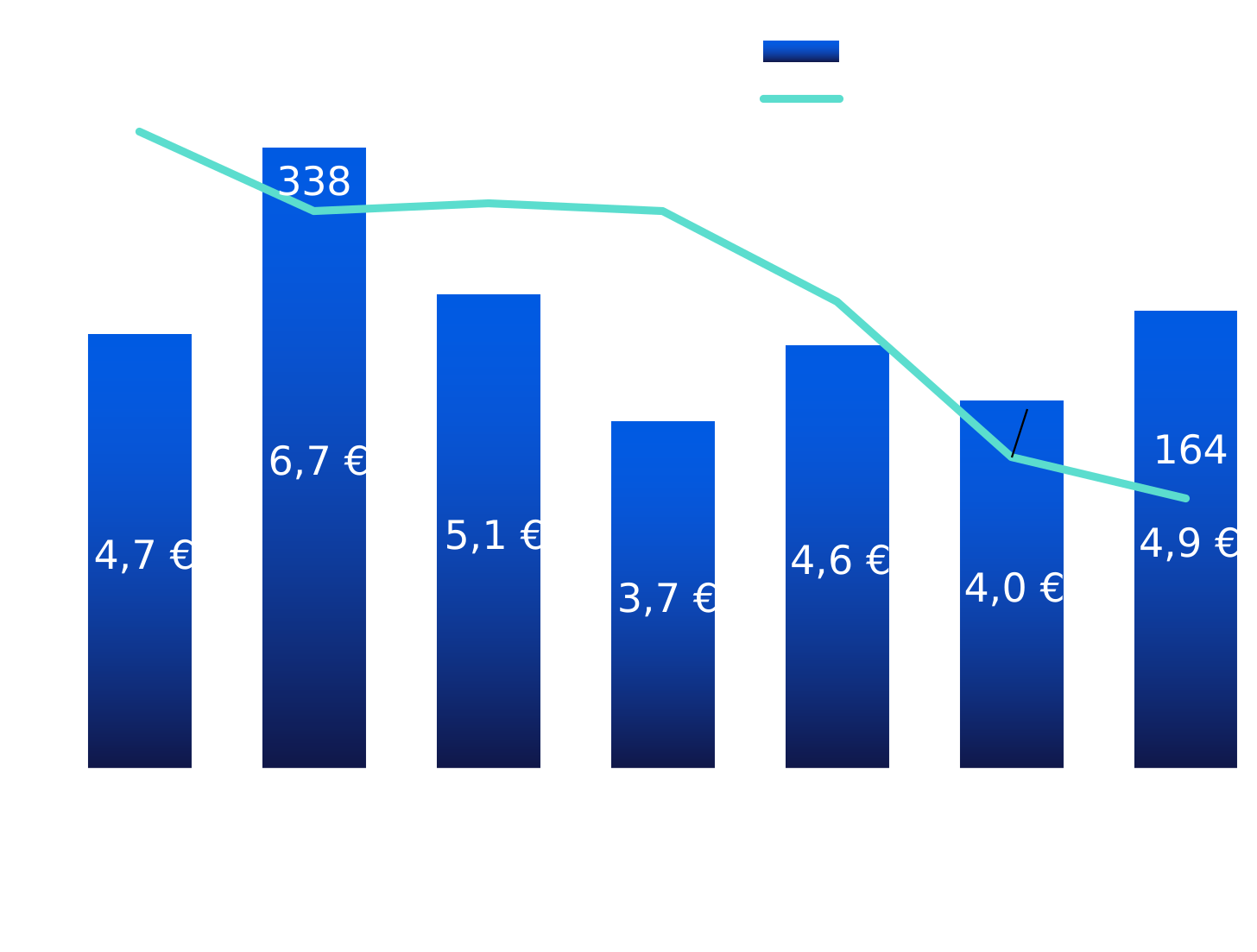
EU27 Cleantech Venture and Growth Investment, 2016 – H1 2026

Executive Summary

EU cleantech venture and growth investment reached €4.9 billion in H1 2026, 8% above H1 2025, as a sharp Q2 rebound to €3.2 billion nearly doubled Q1's €1.7 billion.
The recovery was in value, not volume: only 165 equity deals were recorded in H1, down 42% year-on-year, with Q2's 75 the lowest quarterly total on record.
The contraction is sharpest early-stage, with seed and Series A down 39% year-on-year in Q2 to 56 deals. Late-stage held up better at 19.
The gap with the US narrowed: US investment fell 11% to €4.9 billion in Q2, around 1.5x the EU level, down from over 3x in Q1.
Deals spanned 19 of 27 Member States. Germany led with 39, ahead of France (29), the Netherlands (18), Spain (14), Italy (12) and Sweden (11).
Materials & Chemicals (35%), Energy & Power (28%) and Resources & Environmental Management (18%) captured over 81% of capital invested.
EU cleantech debt investment stood at €3.5 billion in H1 2026, down from €5.7 billion in H2 2025.
Debt volume kept sliding, from 40 deals in H1 2025 to 23, extending the normalisation since the €19.3 billion H1 2024 peak.
With equity thinning at the scale-up stage, debt able to unlock growth-stage financing at scale remains a critical gap, and scale-up equity is even more vital, as it is what unlocks the debt market.
The debate on the Industrial Accelerator Act, unveiled on 4 March with Union-origin criteria for clean tech, continues but has shifted as Member States now broadly back the rationale, with the argument moving to how wide the "Made in Europe" perimeter should be.
On 17 July, the Commission published the ETS revision, with a predictable next decade (LRF 3.7% for 2031–2035) but a weaker long-term signal, putting reform of ETS revenue use, via the Innovation Fund, high on the agenda.
The accompanying Electrification Action Plan sets an indicative 46% electrification target for 2040 and proposes aligning gas and electricity taxation by Regulation.
A financing dialogue convened by Commissioner Hoekstra on 30 June rallied investors, banks and the EIB around the scale-up "missing middle”.
Ireland took over the Council Presidency on 1 July, inheriting the IAA and ETS files and tasked with advancing the 2028-2034 MFF before the 2027 electoral window narrows.

01

1H 2026: Continued decline in investment activity

4.9
billion

INVESTED IN EU CLEANTECH IN H1 2026

Amount invested have rebounded to their highest level in two years, while deal volume fell to 9-year low

EU Investment Rebounds,
but Deal Flow Sinks

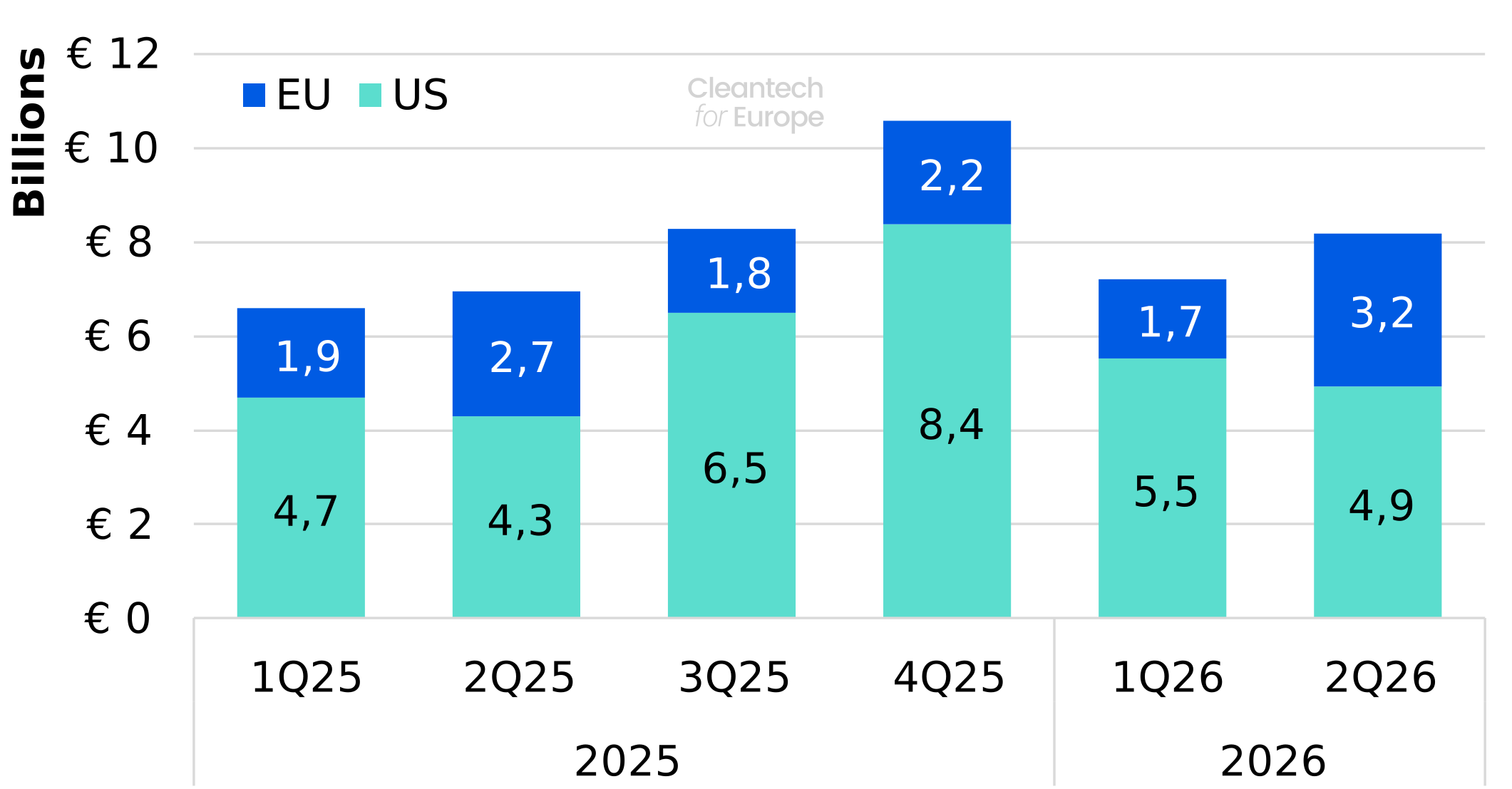
EU cleantech venture and growth investment rose sharply to €3.2 billion in Q2 2026, nearly doubling from €1.7 billion in Q1. This brought H1 investment to €4.9 billion, 8% above H1 2025.
US investment declined by 11% quarter-on-quarter to €4.9 billion, although it remained 15% above Q2 2025. The gap with Europe consequently narrowed considerably: US investment was around 1.5 times the EU level in Q2, compared with more than three times in Q1.
Europe’s topline recovery masks a continued deterioration in deal activity. Only 75 equity deals were recorded in Q2, down from 90 in Q1 and 116 one year earlier – the lowest quarterly total in the period analysed. Across H1, deal volume fell 42% year-on-year, from 283 to 165.
The contraction remains concentrated at the early stage: seed and Series A deals fell to 56 in Q2, down 39% year-on-year. Late-stage activity proved somewhat more resilient, with 19 deals – only one fewer than in Q1 – but remained 21% below Q2 2025. Overall, more capital is being concentrated in fewer transactions.
Cleantech Venture and Growth Investment, EU vs US, 2025 – Q1 2026
EU27 Cleantech Venture and Growth deals by stage, 2021 – Q1 2026

H1 Deal distribution:
geography & sectors

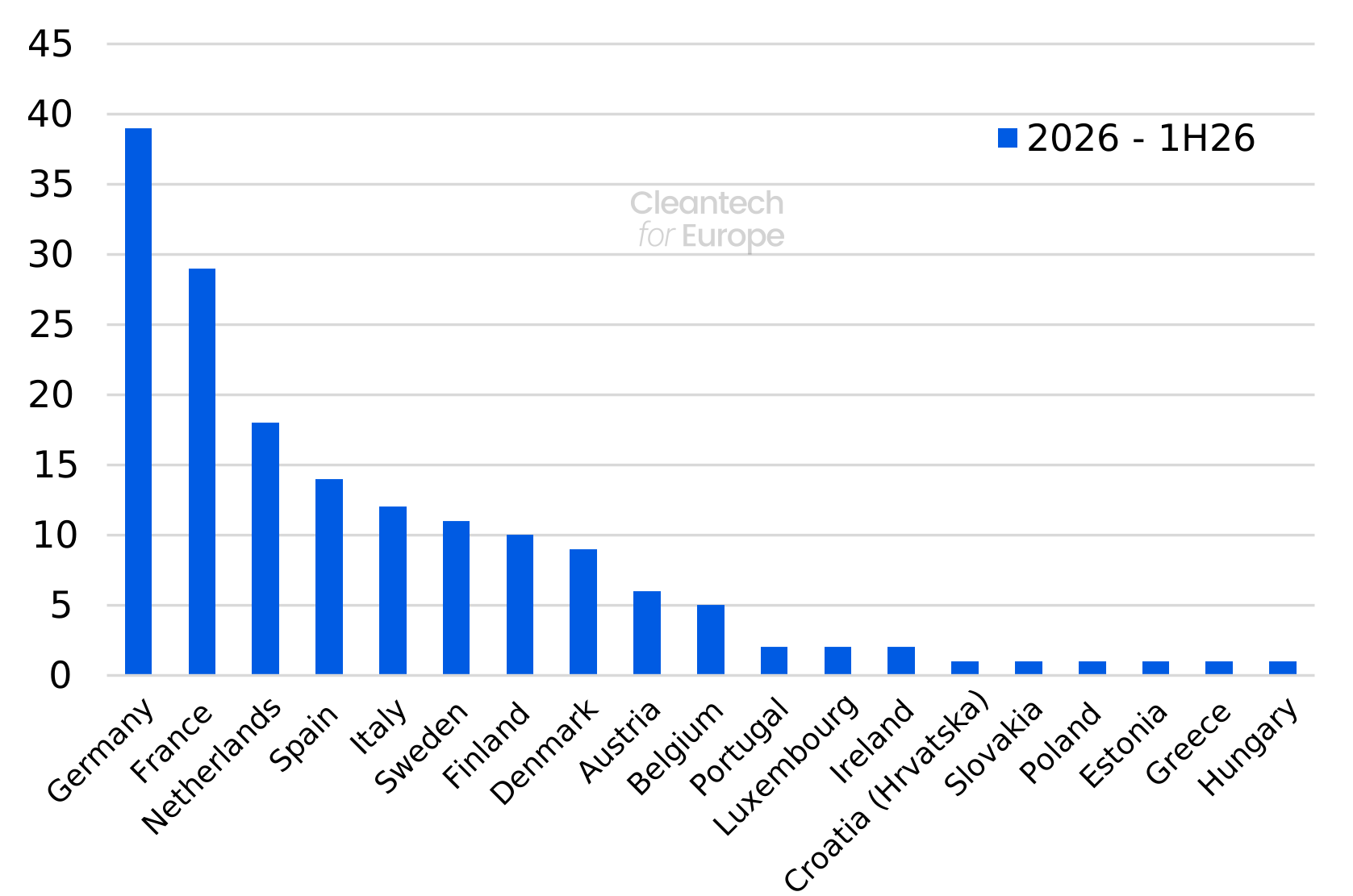
Cleantech venture and growth deals were recorded in 19 of the EU’s 27 Member States during H1 2026, demonstrating broad – if uneven – geographical activity.
Germany led with 39 deals, followed by France (29), the Netherlands (18), Spain (14), Italy (12) and Sweden (11). Germany and France together accounted for 41% of all EU deals, while the four leading countries represented 61%.
Materials & Chemicals attracted the largest share of investment at 35%, followed by Energy & Power (28%) and Resources & Environmental Management (18%). Together, these three sectors captured over 81% of all capital invested.
Transportation & Logistics accounted for 8%, followed by Agriculture & Food (6%) and Waste & Recycling (4%). The distribution points to investor interest shifting towards industrial transformation – including advanced materials, chemicals, energy systems and resource efficiency – while investment remains comparatively limited in other parts of the cleantech economy.
Sustaining a geographically diverse innovation pipeline while helping more companies access scale-up capital remains central to strengthening Europe’s industrial base.
EU cleantech venture and growth deals by member state, H1 2026
EU cleantech venture and growth investment by sector, H1 2026
Q12024_early_Sensors
Sensors
France
€15M
€15M
Q12024_early_Alternativeproteins
Alternative proteins-Q124
Germany
€15M
€15M
Q12024_early_wastemanagementq124
Waste management-q124
France
€21M
€21M
Q12024_early_industrialmaterials
Industrial Materials
France
€23M
€23M
Q12024_early_carbonremovals
Carbon Removals
Germany
€25M
€25M
Q12024_early_energystorage
Energy Storage
Finland
€26M
€26M
Netherlands
€15M
€15M
Q12024_early_transportation
Transportation
Croatia
€99M
€99M
Austria
€20M
€20M
Italy
€15M
€15M
AB2023_early_Construction
Construction
Germany
€45M
€45M
AB2023_early_Hydrogen Fuel Cells
Hydrogen Fuel Cells
France
€46M
€46M
AB2023_early_Nuclear fission
Nuclear fission
France
€50M
€50M
AB2023_early_Supply chain Logistics
Supply chain & Logistics
Germany
€50M
€50M
AB2023_early_EV Charging
EV Charging
Germany
€70M
€70M
AB2023_early_Heat pumps
Heat pumps
Sweden
€86M
€86M
AB2023_early_Carbon Management
Carbon Management
Germany
€100M
€100M
AB2023_early_Green IT
Green IT
France
€100M
€100M
France
€90M
€90M
AB2023_early_Electric Vehicles
Electric Vehicles
France
200M
200M
3Q23__Others__Logistics
Transportation & Logistics
Germany
€177M
€177M
3Q23__Others__Hydro
Green Hydrogen
Germany
€169
€169
Netherlands
€130M
€130M
3Q23__Others__CRM
Critical Raw Materials
Ireland
€184
€184
3Q23__Others__Plastic
Plastic Alternatives
Netherlands
€338M
€338M
Germany
€130M
€130M
3Q23__Others__Energy
Energy & Power
Germany
€685M
€685M
3Q23__Others__EV
EV Batteries
Sweden
1100M
1100M
France
€650
€650
France
€600M
€600M
3Q23__Late__Energy
Energy & Power
Sweden
€45M
€45M
3Q23__Late__Hydro
Green Hydrogen
Portugal
€61M
€61M
3Q23__Late__Agri
Agriculture & Food
Belgium
€72M
€72M
Netherlands
€32M
€32M
3Q23__Late__Solar
Solar
Lithuania
€93M
€93M
3Q23__Late__Construction
Buildings & Construction
France
€106M
€106M
Ireland
€26M
€26M
Netherlands
€25M
€25M
3Q23__Late__EV
EV Batteries
France
€850M
€850M
3Q23__Late__Steel
Green Steel
Sweden
€1500M
€1500M
3Q23__Early__Geo
Geospatial Imagery
Germany
€17M
€17M
3Q23__Early__Transportation
Transportation & Logistics
Germany
€18M
€18M
Spain
€16M
€16M
3Q23__Early__Quantum
Quantum Computing
France
€19M
€19M
3Q23__Early__Energy
Energy & Power
Germany
€25M
€25M
3Q23__Early__Agriculture
Agriculture & Food
Denmark
€30M
€30M
3Q23__Early__Plastic
Plastic Alternatives
Germany
€36M
€36M
Finland
€23M
€23M
3Q23__Early__Construction
Buildings & Construction
Germany
€45M
€45M
Germany
€22M
€22M
2Q23__Late__Carbon
Carbon Management
Luxembourg
€34M
€34M
2Q23__Late__Agri
Agriculture
France
€162
€162
2Q23__Late__EV
EV Charging
France
€252M
€252M
Germany
€153M
€153M
Finland
€66M
€66M
Ireland
€57M
€57M
2Q23__Late_Energy
Energy, Energy Storage & Networks
Germany
€433
€433
Germany
€370M
€370M
Sweden
€90M
€90M
Italy
€41M
€41M
2Q23__Early__Electro
Electronic Devices
Germany
€20M
€20M
2Q23__Early__Biotech
Biotechnology
Germany
€20M
€20M
2Q23__Early__Construction
Buildings, Building Materials & Construction
France
€29M
€29M
France
€20M
€20M
2Q23__Early__Logistics
Transportation, Supply Chain & Logistics
Germany
€41M
€41M
Germany
€29M
€29M
France
€21M
€21M
Austria
€18M
€18M
2Q23__Early__Green-IT
Green IT
France
€91M
€91M
2023-Q1-chart__series-B__geo
Geothermal
France
€45M
€45M
2023-Q1-chart__series-B__waste
Waste Management
Netherlands
€50M
€50M
2023-Q1-chart__series-B__agrifood
Agriculture & Food
Denmark
€65M
€65M
Denmark
€47M
€47M
2023-Q1-chart__series-B__buildings
Buildings & Construction
Austria
€93M
€93M
Germany
€44M
€44M
2023-Q1-chart__series-B__blockchain
Blockchain
No items found.
2023-Q1-chart__series-B__solar
Solar
Germany
€215M
€215M
Italy
€117M
€117M
Sweden
€29M
€29M
2023-Q1-chart__series-A__solar
Solar
Ireland
€15M
€15M
2023-Q1-chart__series-A__heatpumps
Heat Pumps
Netherlands
€15M
€15M
2023-Q1-chart__series-A__fusion
Nuclear Fusion
France
€15M
€15M
2023-Q1-chart__series-A__energy
Energy & Power
Slovakia
€16M
€16M
2023-Q1-chart__series-A__agrifood
Agriculture & Food
Netherlands
€21M
€21M
2023-Q1-chart__series-A__geospatial
Geospatial imagery
Latvia
€28M
€28M
2023-Q1-chart__series-A__transportation
Transportation and Logistics
Germany
€42M
€42M
France
€21M
€21M
Germany
€15M
€15M
2023-Q1-chart__series-A__buildings
Buildings
Sweden
€42M
€42M
2023-Q1-chart__series-A__carbon-management
Carbon Management
Germany
€101M
€101M
2022-Q3-chart__transportation-logistics
Transportation & Logistics
Belgium
€20M
€20M
2022-Q3-chart__carbon-management-02
Carbon Management
Sweden
€45.7M
€45.7M
Germany
€10.9M
€10.9M
2022-Q3-chart__food-waste
Food waste
Sweden
€65.7M
€65.7M
2022-Q3-chart__energy-services
Energy Services
Germany
€214.7M
€214.7M
2022-Q3-chart__green-steel
Green steel
Sweden
€297.8M
€297.8M
2022-Q3-chart__advanced-materials
Advanced Materials, Fuels & Chemicals
Netherlands
€15.1M
€15.1M
Denmark
€11.7M
€11.7M
Netherlands
€11.2M
€11.2M
Denmark
€10.2M
€10.2M
2022-Q3-chart__alternative-proteins
Alternative Proteins
France
€16.8M
€16.8M
Finland
€15.3M
€15.3M
2022-Q3-chart__energy
Energy, Energy Storage & Networks
Netherlands
€30.5M
€30.5M
France
€13.9M
€13.9M
Netherlands
€12.3M
€12.3M
2022-Q3-chart__electric-vehicles-02
Electric Vehicles
Germany
€50.3M
€50.3M
2022-Q3-chart__supply-chain-logistics
Supply Chain & Logistics
Germany
€153.7M
€153.7M
2022-Q3-chart__crop-inputs-02
Crop Inputs
Slovenia
€14.5M
€14.5M
2022-Q3-chart__biomass-waste
Biomass & waste to energy
Germany
€37.7M
€37.7M
2022-Q3-chart__fuel-cells
Fuel Cells
Denmark
€54.4M
€54.4M
2022-Q3-chart__electric-vehicles
Electric Vehicles
Netherlands
€159.7M
€159.7M
2022-Q3-chart__hydrogen
Hydrogen
Germany
€271.3M
€271.3M
2022-Q3-chart__agriculture-food
Agriculture & Food
France
€485.3M
€485.3M
2022-Q3-chart__carbon-management
Carbon Management
Sweden
€11.6M
€11.6M
2022-Q3-chart__hvac
HVAC
Czech Republic
€15.7M
€15.7M
2022-Q3-chart__solar
Solar
Sweden
€22.9M
€22.9M
2022-Q3-chart__crop-inputs
Crop Inputs
France
€23.9M
€23.9M
2022-Q3-chart__construction
Construction
Spain
€37.9M
€37.9M
2022-Q3-chart__ev-charging
EV Charging
France
€180M
€180M
Denmark
€47.2M
€47.2M
Netherlands
€19.9M
€19.9M
Lithuana
€7.2M
€7.2M

EARLY-STAGE INNOVATION FUNDING
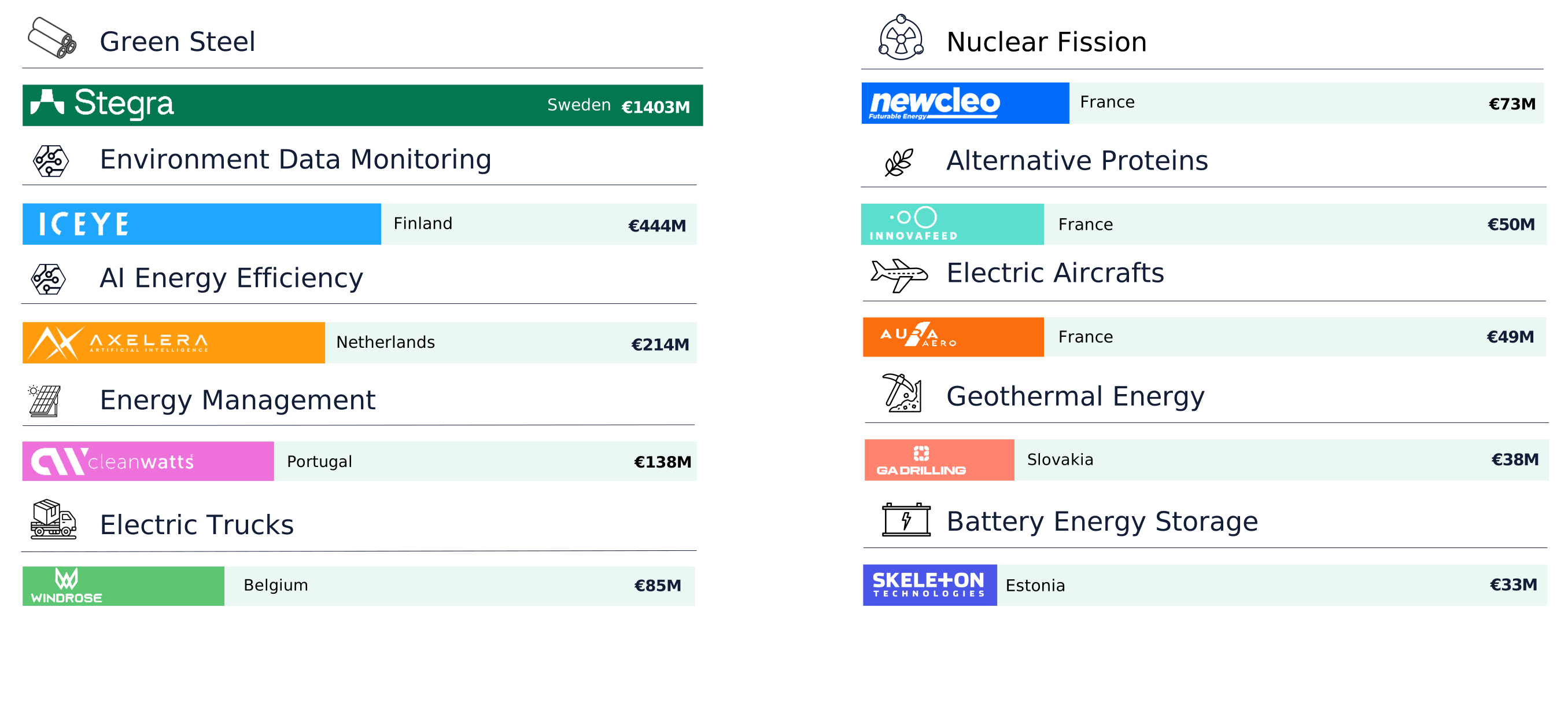
top deals and activities

(Seed and series A)
(Series B and Growth Equity)

THE LATEST FROM THE CLEANTECH INVESTMENT ECOSYSTEM

€1.4b

In March, France-based RGREEN INVEST announced the final close of its INFRAGREEN V fund at over €900 million, backed by the French Pension Reserve Fund (FRR) and the European Investment Fund (EIF). The Article 9 fund targets European mid-market renewable energy, storage, and electrification infrastructure, with a focus on Central and Eastern Europe. In June, the manager followed with the final close of its INFRABRIDGE IV infrastructure debt fund at nearly €500 million - more than double its previous vintage - targeting the underserved European lower mid-market across geothermal, biomethane, energy storage, and hybrid solar-and-wind projects.

€1b

In April, Italy-based Vesper Infrastructure Partners announced the final close of its Next Generation Infrastructure Fund I at over €1 billion, backed by more than 50 institutional investors across Europe and North America including the European Investment Fund (EIF), Generali, Mediobanca, and Italian pension funds. The fund targets European mid-market value-add infrastructure across sustainable and decentralised energy, social infrastructure, digital and data infrastructure, and mission-critical transport.

€750m

In February, Spain-based Mundi Ventures announced the first close of its Kembara deep tech growth fund at €750 million, toward a €1 billion target, anchored by a €350 million commitment from the European Investment Fund (EIF) alongside other tier-one investors. The fund backs Series B and C rounds of around 20 European deep tech companies, with initial checks of €15 to €40 million, across several sectors including clean energy.

€300m

In March, France-based Partech announced the final close of its inaugural Partech Impact Fund at €300 million, backed by Allianz, Bpifrance, the EIF, and British Business Bank, among others. The fund targets European B2B impact-native companies with over €10 million in revenues across clean production, sustainable agriculture, clean construction, mobility, and digital health.

€300m

In April, Netherlands-based Triodos Investment Management and Canada-based Fondaction Asset Management launched Value Nature Fund I, a closed-end natural capital fund with a €300 million target. The Article 9 fund invests in regenerative agriculture and closer-to-nature forestry across Europe, Canada, and the US.

€160m

In April, Denmark-based Kompas VC announced the final close of its second fund, Fund II, at €160 million. The early-stage fund targets industrial technologies that accelerate productivity, resilience, and decarbonization across manufacturing, the built environment, energy, advanced materials, and logistics, including industrial AI, robotics, and cybersecurity.

02

Debt Dive: EU Cleantech Debt Funding

€3.5
billion

H1 2026 EU cleantech debt investment

Debt dive
EU cleantech debt funding

EU cleantech debt investment reached €3.5 billion in H1 2026, down from €5.5 billion in H1 2025 and €5.7 billion in H2 2025, extending the normalisation that has followed the exceptional €19.3 billion recorded in H1 2024. Deal count fell to 23, from 40 in H1 2025, confirming a market increasingly driven by fewer but larger tickets. This concentration reflects lender preference for more mature, de-risked cleantech assets. The half was front-loaded: Q1 delivered €2.3 billion across just 8 deals before activity eased to around €1.2 billion across 15 deals in Q2.
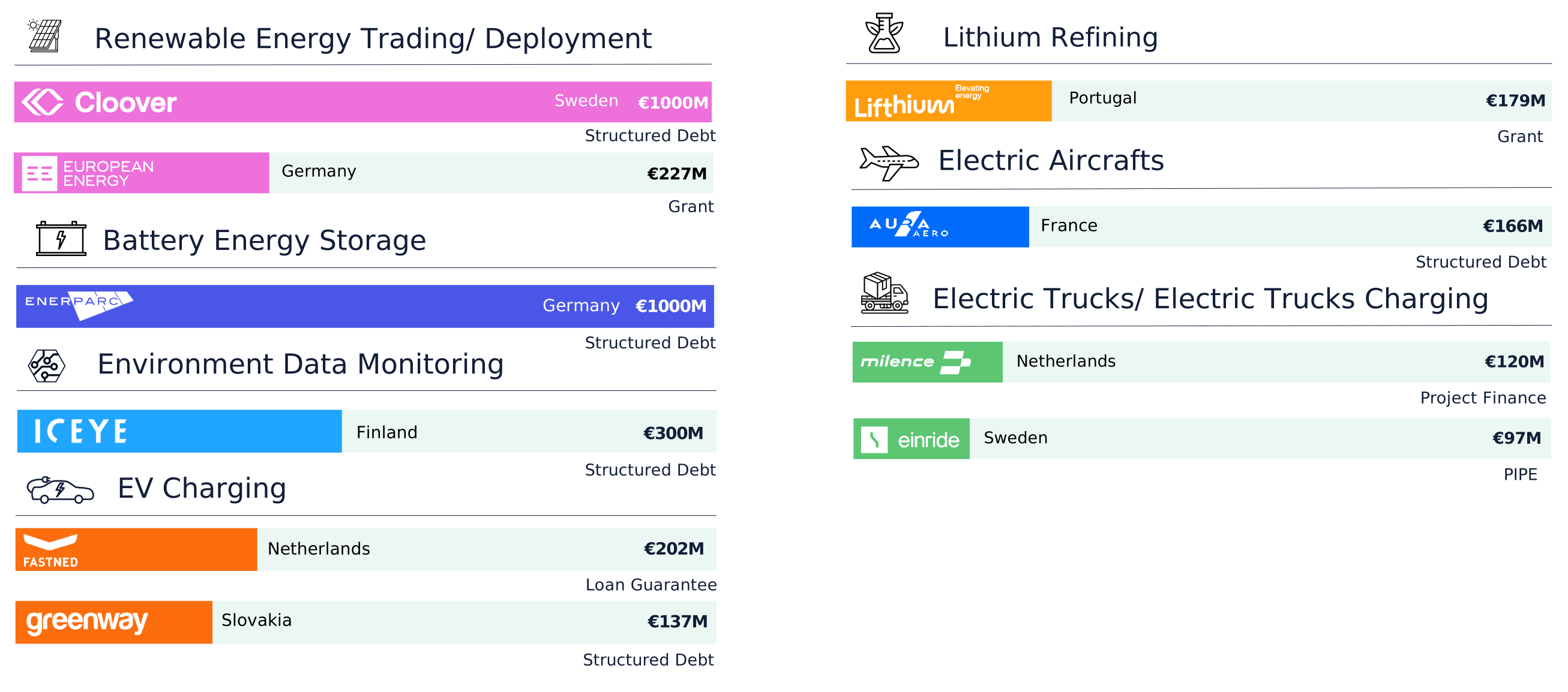
Major debt transactions included facilities to Cloover (€1.02 billion) and Enerparc (€1 billion), and a €300 million revolving credit facility for ICEYE, spanning decentralised energy software, solar and battery storage, and satellite-based earth-observation intelligence. Beyond debt proper, the half also saw strong traction in electric trucking: Einride raised an oversubscribed €97 million PIPE ahead of its June Nasdaq listing, underscoring renewed investor appetite for scale-up commercial-vehicle electrification.
The US remains a far deeper debt market as US cleantech debt reached €23.2 billion across 29 deals in H1 2026, roughly seven times the EU total. Both markets share the same dynamic, though as US deal count fell to a multi-year low.
Unlocking growth-stage debt at scale remains critical for Europe's clean industrial ambitions. As projects mature, bankable business models, blended finance structures and public guarantees will be essential to bridge the gap with deeper credit markets abroad, and scale-up equity is even more vital, as it is what unlocks the debt market in the first place.
EU27 Cleantech Debt Investment, H1 2022 - H1 2026

Top deals and activities

Beyond Equity
A Closer Look

€1.02b

In January, Germany-based Cloover secured a €1.02 billion debt facility from a major European bank, backed by a €300 million guarantee from the European Investment Fund, to scale its AI-powered software and financing platform for decentralised energy across Europe. The capital will be deployed as customer and installer financing to accelerate the rollout of solar panels, batteries, heat pumps, and other distributed energy technologies, positioning Cloover as the "Shopify of Energy."

€500m

In March, Germany-based ENERPARC secured a €1 billion debt package, comprising a €500 million medium-term loan from a consortium of global asset managers, alongside a long-term project financing framework of up to €425 million, with an accordion option that could raise it to €500 million. The capital will support the expansion of ENERPARC's solar and battery storage pipeline across Germany, France, and Spain, funding construction equity and covering both the construction and operational phases of facilities over the next five years.

€300m

In May, Finland-based ICEYE secured a €300 million three-year committed revolving credit facility from a seven-bank syndicate of Nordic, regional, and global lenders, with Citi and Danske Bank. The facility will back guarantees for customer contracts, fund the company's global expansion, and serve as a liquidity backstop. ICEYE operates the world's largest constellation of synthetic aperture radar (SAR) satellites, delivering earth-observation intelligence for environmental monitoring, emergency management, insurance, and defence, and doubled in size in 2025.

€227m

In May, Denmark-based European Energy secured up to €227 million in funding from Germany's hydrogen auction framework, linked to the European Hydrogen Bank, as one of three selected projects. The award will support 150 MW of additional renewable hydrogen production capacity connected to the company's Kassø site in Denmark, expanding its Power-to-X portfolio and helping meet Germany's rising RFNBO targets for transport fuels. It also strengthens the case for a planned hydrogen pipeline linking Danish production to German off-takers.

€180m

In January, Portugal-based Lifthium Energy received a €180 million government grant, provided under the European Union's temporary crisis and transition framework, to build a battery-grade lithium refinery in Estarreja. Once completed in 2030, the refinery will have an annual capacity of 50,000 tons of lithium hydroxide, sufficient to supply batteries for approximately two million electric vehicles, reducing Europe's dependence on lithium imports from countries such as China.

€97m

In February, Sweden-based Einride secured an oversubscribed PIPE of around €97 million from new and existing investors, including EQT Ventures, ahead of its June listing, via a merger with Legato Merger Corp. The raise brought total proceeds tied to the transaction to roughly €310 million, funding the electric and autonomous truck maker's technology roadmap and freight deployments across North America, Europe, and the Middle East. Einride began trading on Nasdaq on 10 June 2026 under the ticker ENRD, at a pre-money valuation of around €1.17 billion ($1.35 billion).

03

Latest from EU Policy

Policy Developments

Irish Council Presidency

Ireland took over the rotating Council Presidency on 1 July, structuring its programme around three pillars — competitiveness, values, and security. On the economic side, its "One Europe, One Market" agenda prioritises deepening the Single Market, to which it adds a clear push on simplification and on advancing the energy transition.  
On industrial and energy files, the IAA is a flagship priority, alongside EU Inc. Above all, Ireland inherits the next Multiannual Financial Framework (2028-2034) as its overarching, cross-cutting task - it must bring the trilogue negotiations to a close before the 2027 electoral calendars in several Member States (France in particular) narrow the political window for agreement.  
It also picks up the freshly published ETS revision, launching Council work on a file central to industrial competitiveness and to the investment signal for cleantech.

Emissions Trading System (ETS) Revision

On 17 July, the Commission published its long-awaited ETS revision. The reform preserves a predictable framework for the next decade with the linear reduction factor set at 3.7% for 2031-2035, but weakens the long-term signal thereafter, dropping to 1.7% from 2036 and allowing up to 2% of high-integrity international credits over 2036-2040.
On the positive side, it better connects carbon pricing with industrial investment as free allocation becomes fully conditional on board-endorsed decarbonisation plans, and Member States must spend at least 50% of ETS revenues on decarbonising covered sectors which is a clear focus on competitiveness and electrification.
The risk is that a weaker post-2035 trajectory dents investor confidence and undermines the cost-effectiveness of the 2040 target. It is a setback for frontrunners that have already invested, but it leaves lagging sectors little room to delay their transformation further.

Grids Package

The EU Grids Package has entered a decisive phase, with both the Council and the European Parliament having adopted their negotiating positions and trilogue discussions beginning in mid-July under the Irish Presidency.
The first negotiations, led by Parliament's rapporteur Nils Fuglsang, have focused on accelerating permit-granting procedures, reflecting broad recognition that lengthy permitting and grid access congestion have become major bottlenecks to Europe's electrification agenda.
In the negotiations, Parliament is advocating for electricity grids and renewable energy projects to be recognised as being of overriding public interest, the introduction of mandatory benefit-sharing mechanisms for local communities, and the use of tacit administrative approval to prevent unnecessary delays.

Industrial Accelerator Act

The IAA amends the Net-Zero Industry Act to link public procurement and support schemes to Union-origin criteria across key clean technologies, the EU's first "Made in Europe" demand signal.
Member States, initially divided, are now broadly aligned on the rationale. The debate has shifted to how wide the "Union-origin" perimeter should be - in effect, how many countries qualify as "Made in Europe."
Timeline: in Council, Permanent Representatives discussed the file mid-July, with a second compromise text expected after the summer. In Parliament, the draft report is due 7 September, amendments 27 September, committee votes in November, and the plenary vote in December, ahead of trilogue negotiations in early 2027.
The key is not to conflate market access with the investment signal that is the text's primary purpose: extending equivalence to all FTA partners lets companies capture European support from third countries without building EU capacity. Only an opt-in regime with reciprocity - starting from the EU/EEA, with trusted partners added under binding conditions - can send a strong, credible signal to private capital.

Investment Booster

The revision of the ETS must now go hand in hand with a broader discussion on how ETS revenues are used, in particular through a reformed Innovation Fund, which needs to send a stronger, more predictable investment signal to cleantech projects and crowd in the private capital that first-of-a-kind projects require.
The revision also anchors a new EU-level investment architecture, a two-phase Industrial Decarbonisation Bank, starting with the Investment Booster from 2028 and moving to competitive support through carbon contracts for difference and carbon premiums, while broadening the Modernisation Fund to industrial decarbonisation and electrification.
Crucially, it introduces the first explicit links between Member State ETS revenues and EU-level funding, including voluntary auction-as-a-service and a new priority-spending category letting governments top up common European instruments. This is the legal basis for channelling national revenues into shared cleantech investment tools.

04

What the future holds

in focus
Electrification Action Plan

A new direction for EU energy policy. Published by the Commission on 17 July alongside the ETS revision, the Electrification Action Plan places electrification at the foundation of Europe's energy security strategy, framing it as a driver of lower fossil imports, competitiveness and industrial transformation. It sets an indicative 46% electrification target for 2040 - up from around 23% today, via 32-33% by 2030.
Energy taxation. After five years of deadlock on the Energy Taxation Directive, the Commission proposes to align the taxation of gas and electricity through a Regulation that bypasses Council unanimity. Today gas is taxed on average twice as heavily as electricity across the EU.
Network tariffs and infrastructure. The plan would make system-friendly network-tariff design mandatory  (equal weight to CAPEX and OPEX, rewards for batteries and smart meters, and locational and time-based signals) and links electrification to the grid and zero-emission capacity needed to decouple power prices from gas.
Made in Europe. It encourages Member States to apply IAA-style "Made in Europe" criteria (EU plus trade-agreement partners) in social leasing schemes, ahead of the conclusion of the IAA negotiations.
A strong signal for cleantech demand. A strong first step, warmly welcomed: the plan finally moves electrification toward the centre of post-2030 energy policy. Measured as electricity's share of final energy, 46% is a highly ambitious signal - the ratio climbs only slowly until fossil assets are displaced, so the target points to electrifying the large majority of Europe's vehicle fleet and building heat within roughly fourteen years. That is exactly the kind of long-horizon demand signal cleantech needs to scale up, provided it is anchored as a binding pillar of the autumn energy security framework and matched by the deployment pace it implies.
For more on this topic:

The Electrification Action Plan

Strategic Perspectives, Boosting Electrification in Europe

Latest news
from Cleantech for Europe

Cleantech Friendship Group In Action

The Cleantech Friendship Group had a busy end of the year, taking its cross-party push for European cleantech from the European Parliament to the industrial heartland.
In Strasbourg, CFG members met US Democratic House Representatives (SEEC) to compare notes on the clean industrial transition. Despite federal rollbacks, US cleantech demand is proving resilient, and as US carmakers retreat from EVs, foreign, notably Korean, manufacturers are gaining ground.
Also in Strasbourg, the CFG welcomed Commissioner Wopke Hoekstra ahead of the ETS revision. The message was that carbon pricing remains the biggest driver of Europe's cleantech business case, and ETS revenues, via a reformed Innovation Fund, must be channelled into European industry.
At the Future Cleantech Architects Festival in Remscheid, CFG members and EIC Board President Michiel Scheffer toured steel recycling, low-carbon construction and industrial-heat sites as a reminder that "Made in EU" is a competitive advantage, not just a label.

Cleantech for Europe Mini-summit

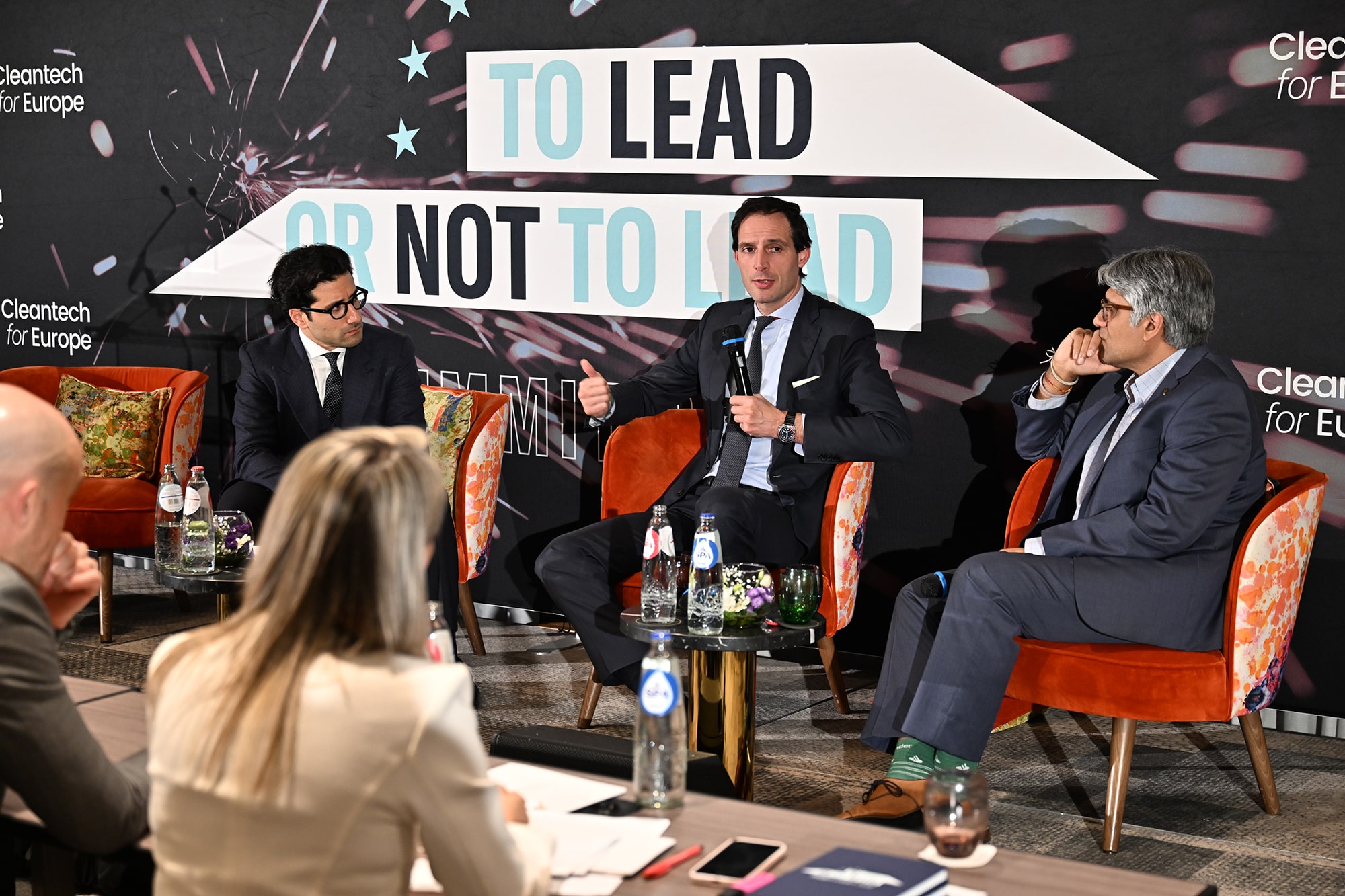
On 30 June, Cleantech for Europe convened its members - leading scale-ups, investors and philanthropists - in Brussels to take stock of the ecosystem's priorities with policymakers and sharpen the coalition's advocacy strategy for the months ahead.
The day's sessions ranged across the future of the ETS with its founding father Jos Delbeke and DG CLIMA Director-General Kurt Vandenberghe, the Industrial Accelerator Act with ITRE rapporteur Christophe Grudler, and cleantech's intersections with security, defence and AI.
A highlight was the financing roundtable convened by Commissioner Wopke Hoekstra, bringing together pension funds, the EIB, venture capital, private equity and banks. The diagnosis is that Europe has no capital shortage, but struggles to move capital to where it is needed, as the scale-up "valley of death" captures just 10-15% of funding, against roughly 45% for the early and late stages. Bridging it requires credible demand-side policy, long-term regulatory stability (an undermined ETS would cripple the investment case, and Member States should direct more ETS revenues into cleantech), and real progress on a Capital Markets Union to unlock cross-border investment.
The day closed with a summer reception hosted by Cleantech Friendship Group MEPs - Lídia Pereira, Thomas Pellerin-Carlin, Sara Matthieu, Annalisa Corrado and Martin Hojsík - at the European Parliament.
Download the printable version
Policy Voices
Policy Voices
Scale-up Coalition
Scale-up Coalition
Industrial Decarbonisation
EU Funding
EU Funding
Regional Initiatives
Company News
Company News
In the Press
In the Press
Voices of Innovation
Cleantech Investors
Cleantech Investors
Policy Voices
Policy Voices
Scale-up Coalition
Scale-up Coalition
Industrial Decarbonisation
EU Funding
EU Funding
Regional Initiatives
Company News
Company News
In the Press
In the Press
Voices of Innovation
Cleantech Investors
Cleantech Investors