Cleantech for Europe‘s Policy Update - May Edition
June 3, 2026

No More Dependencies: Why Europe Needs Cleantech More than Ever
Welcome to the latest edition of Cleantech for Europe’s Policy Update, your one-stop-shop for EU cleantech policy news and analysis. In this Policy Update, we cover:
On May 19, President Ursula von der Leyen addressed Europe's clean tech community at the European Clean Tech Conference 2026 in Brussels, framing the sector – which creates 100,000 new jobs each year – as central to Europe's security, competitiveness, and climate ambitions.
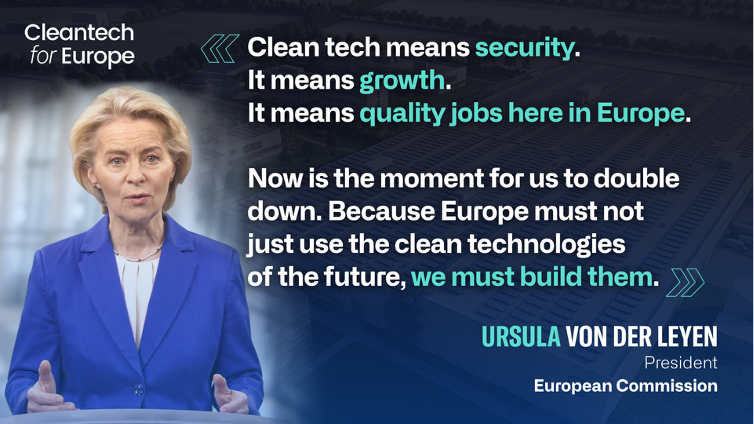
Against the backdrop of the Middle East war and its ripple effects on global energy markets, the President underlined that fossil fuel dependency remains Europe's core vulnerability. Three priorities emerged from her address:
⚡ Electrification as the path to independence. With EV purchases up 51% since the outbreak of the conflict, consumer momentum is building. The Commission will present an Electrification Action Plan setting clear targets to permanently reduce Europe's exposure to fossil fuel price shocks.
🌍 Cleantech made in Europe. Amid intensifying and often unfair global competition, the President reaffirmed the logic of the Industrial Accelerator Act: public money should flow to European industry, with "Made in EU" and low-carbon criteria embedded in public procurement.
💶 Redirecting ETS revenues toward clean industry. Since 2005, ETS-covered sectors have cut emissions by 39% while the economy grew by 71%, generating over €260 billion. While EU-level revenues are fully reallocated towards innovation and decarbonisation, national-level allocation remains inconsistent and often not fully transparent. The ETS reform this summer must ensure these revenues are channelled back into the clean industries of tomorrow.
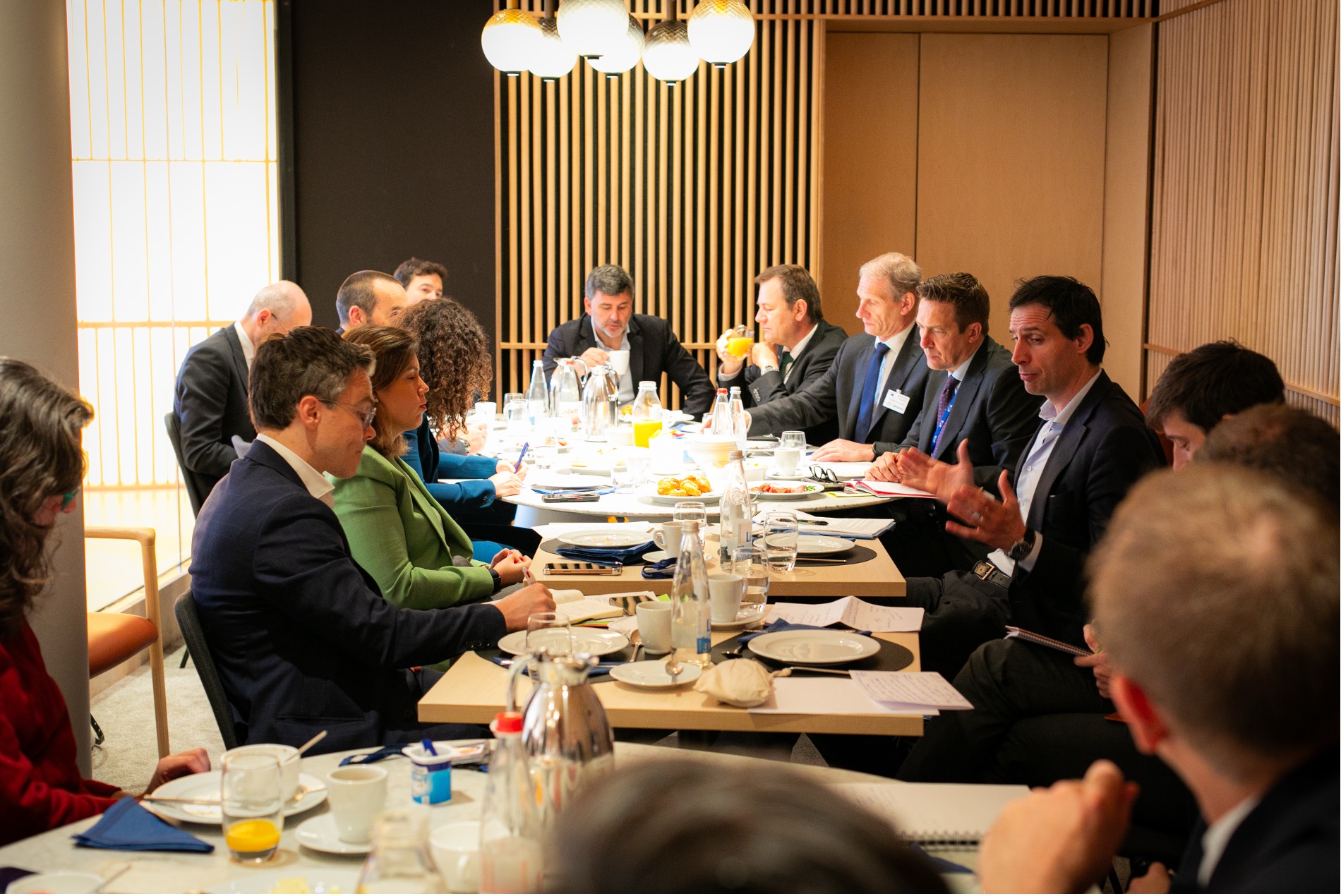
Ahead of the ETS revision this summer, the Cleantech Friendship Group welcomed Commissioner Wopke Hoekstra at the European Parliament in Strasbourg on May 20 for a timely discussion on carbon pricing, the Innovation Fund, and European industrial competitiveness. The session was co-chaired by MEPs Lídia Pereira and Thomas Pellerin-Carlin.
The Commissioner identified three core dilemmas for the upcoming reform:
⚙️ Ensuring the system rewards those who invest and innovate;
💶 Redirecting ETS revenues – currently flowing overwhelmingly to Member State general budgets – back into European industry and cleantech;
📣 Making a more assertive public case for the ETS at a time of growing political pressure.
Participants broadly agreed: carbon pricing remains the most powerful driver of the cleantech business case in Europe. But with some Member States pushing back on the ETS trajectory amid energy market volatility driven by the Iran war, the reform must deliver on one clear principle – public revenues generated by European industry must flow back to accelerate its clean transition.
The Industrial Accelerator Act was meant to mark a turning point in EU industrial policy as the first time the European Union would systematically link public support to Made in Europe requirements. But as drafted, it will not deliver on this promise.
In its position paper published on May 28, Cleantech for Europe identifies the structural loopholes that risk neutralising the IAA's industrial logic before it even enters into force: an overly broad definition of Union-origin that creates clear incentives for circumvention, waiver provisions that public authorities may systematically invoke, and critical gaps in technology and value chain coverage.
The legislative process now underway is the last opportunity to turn a weak proposal into the credible industrial policy instrument Europe urgently needs. Co-legislators must act on six key recommendations:
🔹 Tighten the geographic scope of Union-origin requirements
🔹 Close value chain gaps in NZIA strategic technologies
🔹 Strengthen 'disproportionate costs' waiver provisions
🔹 Ensure Union-origin requirements do not undermine FDI conditionality
🔹 Refocus automotive local content rules on strategic components
🔹 Build credible lead markets for low-carbon materials
Electrolysers for Europe (E4E) is the unified voice of Europe's electrolyser manufacturers, with Cleantech for Europe managing its secretariat. As global competition accelerates and strategic value chains are being reshaped, the next five years will determine whether Europe builds or loses leadership in electrolysers. The Industrial Accelerator Act is a key test.
But as currently drafted, it risks increasing compliance costs without delivering the demand signal the industry needs. E4E's position paper sets out four priorities for co-legislators:
🔸 Clarify Union-origin requirements to focus on high-value components, excluding non-strategic Balance of Plant elements
🔸 Narrow the geographic scope to the EU and EEA, with the UK as a trusted partner from day one
🔸 Extend Union-origin requirements to hydrogen technologies in public procurement
🔸 Apply Union-origin requirements to 100% of hydrogen auction volumes
Europe still leads globally in electrolysis. This legislative cycle will determine whether it stays that way.
On May 7, the European Commission approved a €5 billion German State aid scheme supporting industrial decarbonisation across ETS-covered sectors, including steel, cement, chemicals, glass, and paper. Aid will take the form of 15-year two-way carbon contracts for difference, covering the additional costs of cleaner production. Eligible technologies include electrification, hydrogen, biomethane, and CCS/CCU.
It is a notable signal for the broader EU debate. The scheme demonstrates how ETS revenues and carbon pricing mechanisms can be actively recycled into industrial decarbonisation, precisely the logic at the heart of the upcoming ETS reform.
The European Commission has selected 65 projects across 10 European countries under the first Innovation Fund pilot auction for industrial process heat. Together, the projects will receive around €400 million in ETS-funded support and are expected to avoid more than 6.6 million tonnes of CO₂ emissions over 10 years.
The selected portfolio is heavily dominated by industrial electrification technologies, including direct and indirect resistance heating, heat pumps, electric boilers and hybrid systems, alongside a smaller number of solar thermal projects. Sectors represented include pulp & paper, chemicals, food & beverage, pharmaceuticals, glass and steel.
The auction attracted 85 applications requesting around €1.4 billion in support – exceeding the initially available €1 billion budget. Yet the Commission ultimately selected 65 projects representing around €400 million in support for grant agreement preparation, demonstrating the selectivity of the pilot round.
The Commission has already announced a second €1 billion heat auction for 2026.
Kompas VC closes €160M Fund II to back industrial decarbonisation – Denmark-based Kompas VC reached final close on its second fund at €160 million, targeting early-stage startups deploying industrial AI, robotics and advanced materials across manufacturing, energy, logistics and the built environment. The fund expects to back up to 25 companies, with seven already in portfolio including bio-manufacturing platform Epoch Biodesign and AI energy optimisation platform Tibo Energy.
Mantle8 raises €31M to scale natural hydrogen exploration – Grenoble-based Mantle8 secured a €31 million Series A led by Sandwater, with participation from Breakthrough Energy Ventures and Bpifrance, bringing total funding to €37 million. The capital will fund the world's most advanced natural hydrogen exploration and drilling campaign, leveraging its proprietary subsurface imaging technology. With projected production costs as low as €0.80/kg, the company aims to deliver commercially viable natural hydrogen by 2030.
Lithosquare raises €22M to apply AI to critical minerals exploration – French start-up Lithosquare secured €22 million from World Fund and Kindred Capital, with participation from Daphni, Omnes Capital and Ovni Capital, to scale its AI-based geological platform for identifying critical mineral deposits including copper, lithium and rare earths. The raise comes as competition over critical raw materials intensifies globally, with European supply chain resilience increasingly at stake.
Barocal raises €8.5M to reinvent heating and cooling – UK-based Barocal secured a €8.5M seed round led by Breakthrough Energy Discovery, alongside World Fund, Cambridge Enterprise Ventures and IP Group, to commercialise its solid-state cooling and heating technology. Based on breakthrough research on caloric materials from the University of Cambridge, the platform is designed to replace century-old vapour-compression systems at cost parity.
· Beijing's Critical Raw Material Weapon - And How to Dismantle It – EUISS’ Joris Teer charts the risks of China's control over critical raw materials for Europe's security and prosperity and sets out urgent steps to diversify supply, strengthen deterrence and regain leverage
· New Wave: “Wave energy could surpass global nuclear capacity” – CorPower Ocean's co-founder & CEO Patrik Möller speaks about the future of wave energy
· Cleaning Up: Europe Needs Clean Tech More Than Ever – MEP Thomas Pellerin-Carlin discusses the need for a clean energy transition for the Europe's survival in a volatile world


