Jules
Our energy system is currently under attack. From pipelines blown up in Saudi Arabia to power stations and heat networks repeatedly being hit in Ukraine, the energy war is back on the global scene. And in this new wave of conflict, Europe is incredibly vulnerable.
Most of the energy we consume comes from fossil fuels, which obviously we don't produce, and our energy infrastructure is very centralized, or in other words, quite easy to attack. Since the start of the US war in Iran, Europe has lost hundreds of billions of euros in extra fuel bills, money that could easily have been invested in our health, in our defense, and of course, in our clean industry. And we might now even have fuel shortages staring down at us in a few months.
So this renewed challenge really confirms what we've known for years, which is that Europe's energy system needs to move from a fossil-based system to a clean energy-based system. And that in the process, Europe must also reinforce its energy security by decentralizing the system, by manufacturing key components at home, and of course, by embracing new energy sources. This is why we keep calling clean technologies Europe's first line of defense.
And over the past decade, we've seen technologies like solar PV and lithium-ion batteries really explode in scale and reduce significantly in cost. But other innovative technologies are now moving much closer to commercial maturity. And that's the case of next-generation geothermal energy, with technologies such as enhanced geothermal systems, which, according to think tank Ember, could cost-effectively replace up to 40% of the EU's coal and gas-fired power generation.
So the question for us today is, is Europe really ready to turn its underground heat into power? I'm Jules Besnainou and you're listening to Time to Scale, the podcast by Cleantech for Europe.
Today, we have a very special episode for you, as we're welcoming not one, but two exceptional guests.
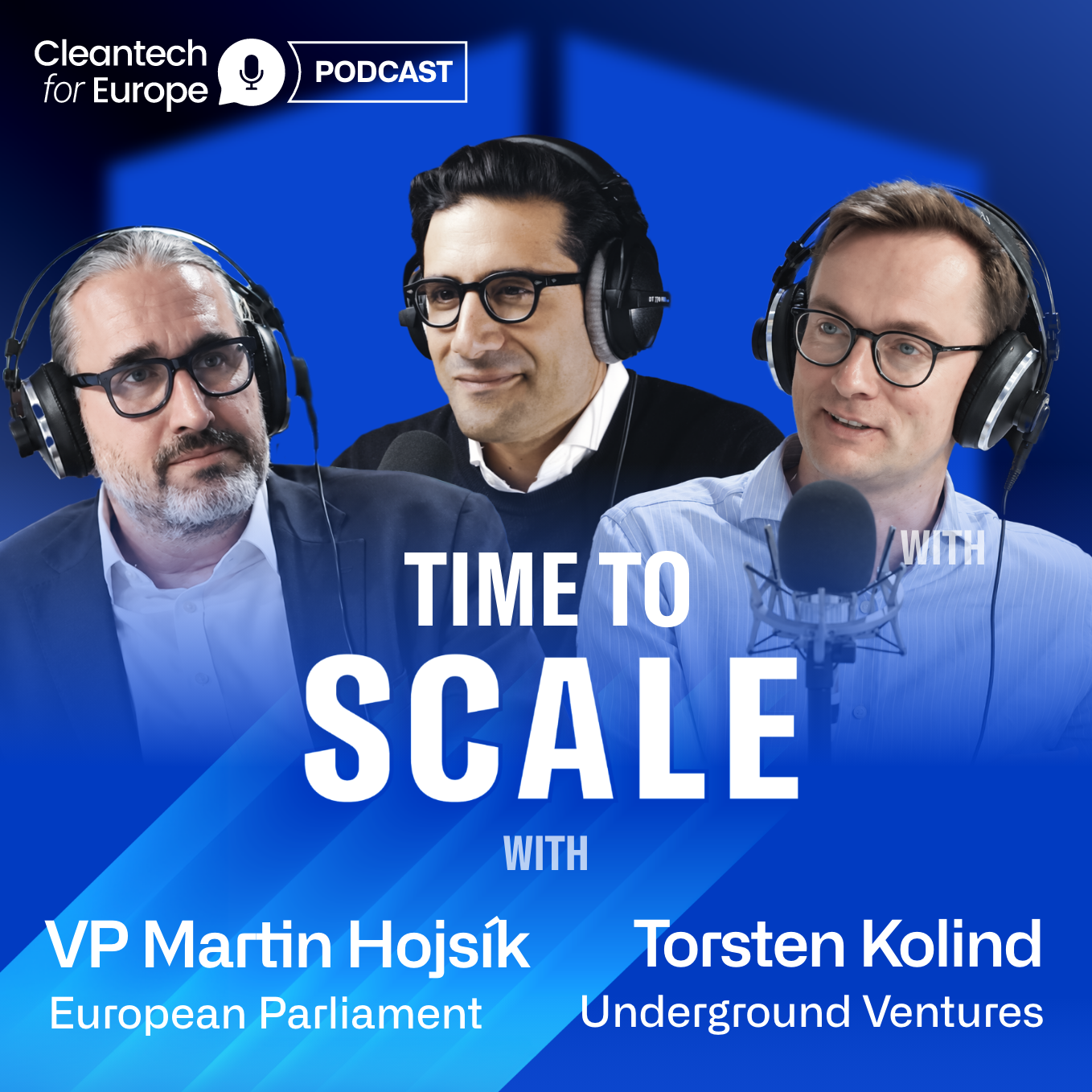
And we're recording straight from the heart of the European Parliament here in Brussels. We're incredibly honored to have with us today MEP Martin Hojsík, who is the Vice President of the European Parliament.
VP Martin Hojsík
Thank you, it's a pleasure to be here.
Jules
Vice President Hojsík, for our listeners who may not know you, you've been a staunch champion of geothermal energy for Europe, and you've just launched a new geothermal working group for the Cleantech Friendship Group in the European Parliament. And I should say you've given a special license to call you Martin today.
VP Martin Hojsík
Yes, indeed.
Jules
Excellent. And joining us all the way from Denmark, we have Torsten Kolind, who's Managing Partner at Underground Ventures, which is the world's first venture capital firm entirely dedicated to investing in geothermal technologies. Welcome, Torsten.
Torsten Kolind
Thank you for the invitation.
Jules
Excellent. So to kick us off, we're here in the European Parliament, where decisions that are made here impact really millions of citizens across Europe.
I'd like to start with you, Martin, and just tell me if my opening picture was maybe a bit too bleak. What is the current challenge that the EU faces when it comes to energy security?
VP Martin Hojsík
I would say it wasn't too bleak. But it's even more complex than that. Because, yes, Houston, actually not Houston in this case, but Brussels, Paris, Bratislava, and every village in Europe, yes, we indeed have a problem.
And we have this problem for years. And we haven't dealt with it. Not sufficiently.
There is, and let's be honest, if Europe wouldn't develop the renewable energy as it did over the last few years, the problem we would be facing right now would be really, really much, much, much, much worse. The bills would be higher, the prices would be higher, everything much worse. But we haven't done enough.
And part of it is because we haven't utilized full potential of all the clean technologies. And the one that's closest to my heart that's underutilized is geothermal. Both the existing one, so the geothermal potential with the already deployed technologies is fully not utilized by far. There are projects drilled in the 90s that are not yet heating the homes in my own home, Slovakia. But also there is this race on the next generation that's starting, which is also going to be defining the competitiveness.
Because ultimately the energy we need, and that's the one thing we don't realize about geothermal, it's all under our feet. We are living on a very thin crust of a planet that's really hot. And yes, it's great that we are capturing the sun.
It's great that we are using the wind. But we don't look enough under our feet. Also because what's under our feet is very secure.
You can't hit it. And this is where I believe we as a Europe are not fully grasping the challenges, the need to have reliable homegrown energy that no one, not Putin, not Trump, no one can turn off. And I think this is really important foundation and we need to finally wake up and start acting on it with much more urgency.
Jules
Do you feel like your peers in this building and across at the European Commission get this level of urgency that we're in for our energy system?
VP Martin Hojsík
I'm there to say that in the Parliament it's growing. I'm happy and I'm really, really happy to see that within the Cleantech Friendship Group there is a growing interest. That's why we established the working group.
And we had a resolution on geothermal back in 2024. My concern is more at the other house. My concern is that I don't see the Commission doing enough.
And I've been critical of the Commission on this towards the end of the previous mandate, also in the current mandate. They haven't delivered. And I think this is the time where, well, in the Parliament, we have to take the initiative.
We have to look for allies among the member states and get the action delivered.
Jules
Torsten, before we go to the heart of the topic, which is geothermal, do you agree with this picture about where Europe is at the moment? I mean, you travel quite a lot. You were in the U.S. last week. What is our energy situation like compared to global peers?
Torsten Kolind
Yeah, I'd agree with Martin a lot here. Absolutely. And also on the lack of urgency.
It's interesting. You mentioned the U.S. and, you know, they are on things like geothermal, they're pushing very, very aggressively from both the federal side and on individual states. But Europe's need for this is so much greater than the U.S.’ need for this. And so in some sense, as a European, you can't help by thinking, why are we not pushing for this? And I think he brought up all the right arguments. The only thing I would add is that we also, we have quite a lot of renewables in Europe, which is great.
But we also need to deal with the intermittency of what if the wind doesn't blow or the sun doesn't shine? And I think that is also a resilience question. You know, and we saw it with the power outages in Spain recently.
You know, there's fuel supply, but there's also intermittence of renewable sources. So we have to build something that is just more resilient from the design side.
Jules
So let's jump straight into it, Torsten. Maybe take us into the wonderful world of next-generation geothermal. What is it and how different is it from the conventional geothermal we've known for decades?
Torsten Kolind
Yeah, exactly. To me, next-generation geothermal is all about utility-scale energy systems that do not require a natural water layer in the ground. Because that's really the thing.
We have done, where there has been these water layers, we have done conventional geothermal for 50 years. And you go to Iceland, you know, that's practically all they do. But this idea of being able to generate both heat and power without having any existing water layers in the ground really takes us from less than one percent of the surface of the planet to, in theory, anywhere.
And I think that is a limitation that has kept geothermal back for a long time. And it's only really within the last five years or so that we have managed to overcome that barrier. So next-gen, for me, there are different ways to do that.
But really, it's all about being able to engineer these systems and be not dependent on existing water resources.
Jules
So what's the state of the art, right? Is this already being done somewhere on the planet? Are we at the first kind of early deployments? Where are we?
Torsten Kolind
It's very much being done. And I think if you look to our friends in the U.S., you can see there's a company called Fervo Energy, which just last week started supplying its first electrons to the grid over in the Western U.S. And they have gone in less than about three and a half years from when they went into the ground to basically the first electricity is being produced. And in another about year, year and a half, they will have completed 500 megawatts of electric capacity in this system. And just think about it for a moment. This is baseload power.
It's not wind turbines and solar. This is equivalent to building a nuclear power plant that you're doing in less than five years. That's where this technology is today.
This is they started last week producing to the grid. So we absolutely are able to do this. We do it in different ways depending on where you are in Europe.
But so much has happened in the last five years. It's really quite amazing.
Jules
What's the potential impact? I mean, you're saying this opens the map, basically. If we look at Europe, does that mean the whole of Europe is now available for this kind of technology?
Does that get us out of the perennial kind of nuclear versus gas debate in some countries?
Torsten Kolind
I think I would say on that we need everything everywhere all at once. So I'm not here to say whether it's better or worse than nuclear. But it is true you can do it anywhere.
But of course, we have a sort of different hotspots around Europe where you see that the relative depth to a level of heat that is sufficient to produce electricity at any kind of economical conditions, that varies a lot. Again, if you're in Iceland, you just have to stick your finger in the ground and you're fine.
But there are certain places in Europe where you might have to drill five or ten kilometers in order to get to that level of heat. So what we are looking at a lot is how do we invest into those technologies that allow us to go to any depth so that this truly becomes a Europe-wide energy source. But that is a big variable that I think is important to remember.
VP Martin Hojsík
Just to comment on this, and that is where actually while we are really and should be investing and developing also as a Europe to be, and we have been good in engineering. This is something which we underestimate. This is an engineering challenge.
It's not about chips. This is back to good old school engineering to be able to have these technologies and not be dependent again on Americans. Japanese are putting I think 600 million dollars into this.
Turks are going into this. This is loads of interest because this is autonomy. So not to be dependent on the technologies but also have it as our competitive advantage as a Europe and start utilizing what we already have.
I come from Slovakia. The Pannonian Basin has unique potential in relatively shallow depth. It's one of the best places in Europe.
We don't use it properly and I think this is a big mistake. So while we're developing new ones so we can really go and have geothermal anywhere, we should start gradually working on it where it's closer to learn, to improve the know-how, to actually harness the energy. And yes, I fully agree with the baseload and with this really fantastic capacity there.
But it's not only electricity. It's heat. And for me, when you were saying gas versus nuclear, I would say one thing.
It's not all no gas. I think what we need to get rid of are the fossil fuels and really this is where it can help us massively to get rid of gas. And last but not least, this is something which is really great in terms of the security.
Because geothermal, most of the stuff is underground. You don't need a lot of space. It's very conservative in terms of the space it occupies.
But also, and that's why you see the Pentagon heavily investing in geothermal because it's a secure thing in the age of drones. It's not exposed to outside. And because you can build lots of the sources, smaller and bigger, some of them can supply a small town, you are way more resilient.
You are in sadly an age where you have to look at the security as a very important component. This is something where geothermal can deliver huge benefits. And I'm still fascinated, sadly, or saddened that Europe is not embracing it fully.
And that's what brought me to action.
Jules
We'll get a bit to why that is and how we solve it. Maybe first, Torsten, if you could help us with a bit of a technology understanding here. You're obviously a global investor.
So you see these technologies around the world. Does Europe have unique strength here and unique kind of technological advantage? Or is it still catching up to other continents?
Torsten Kolind
Yeah, you're right. And just to preface that, we are at Underground Ventures, one of the top five leading investors globally in this space. And we have invested sort of equivalently in North America and Europe.
So I feel fairly well connected to both markets here. It is a little different. I think the US is very, very focused on delivering electricity as fast as possible, as efficiently as possible with geothermal energy right now.
That is the priority. It's a federal priority. It's a local state priority.
It's what all the hyperscalers want. So there is a fit there that is bringing a lot of innovation very quickly out to the market. And that benefits us because we can let them do a lot of the initial investments into testing and seeing what works.
And we can basically pick and choose the best pieces for Europe. So that's not a problem at all. It's actually a very good thing.
In Europe, we are, as Martin said, very good engineers. We are fantastic at building new tools for this market. And one of the things we're very good at is drilling.
So we are building a number of startups. I think there's about ten or so around Europe within the space of advanced drilling. And this is, you might say, well, why do we need new startups for that?
Because the oil and gas industry has drilled a lot of wells over the past 50 years. But the thing is, oil and gas really only needs to drill very shallow. And they really only need to extract some hydrocarbons and then they're done.
When you do geothermal, you need to carefully engineer a high-performing system. So you need to go deeper. You need to go through hotter rock.
You need to be able to steer while you drill. You need to be able to do loops and all sorts of amazing things. And Europe is leading that path in Europe.
So a number of different startups, even all the way up to improving on residential geothermal. Building very small wells, 100, 200 meters next to your house. We have several robotics companies in Europe that are building autonomous robots to drill the well outside your house without having to get a truck and people on site and so forth.
It's really quite amazing that we have such a strong position there. And again, we don't need it across the board. As long as we're friends with others, they are more than happy to share and export their technologies.
Jules
So compared to batteries or other spaces where we're really struggling against global competition and keeping some kind of tech advantage, this is an area where Europe has a part to play in terms of tech leadership.
Torsten Kolind
Yeah, and I think there's a huge difference to things like batteries and photovoltaic cells because this is not about a commodity that needs to be produced in very large numbers at very low cost.
You know, we have heat beneath our feet, you know, anywhere. And we don't need anything for this. We're really just drilling holes in the ground and pouring cold water down and getting steam up, hot water, steam up to produce energy.
So we are not, it's not a risk that let's say other markets around the world would overtake us in terms of building things cheaper or faster. This is very much about engineering these systems and nature takes care of the rest for us. So it's a very different situation than when we have been taken over by others in the past.
Jules
But do you still see a risk that if we don't grow this ecosystem fast enough in Europe, that a lot of the technology providers will still go and move to more active markets in the US?
Torsten Kolind
Yeah, I think the way, this is a very global market today, first of all. So if you are really good at building, you know, turbines for geothermal power plants or drilling equipment, you go where that market is. So for instance, Fervo, the company I mentioned earlier, a big US company that went public earlier this year, they get all of their power plants from an Italian company called Turboden.
They are great at it. And that Italian company, of course, is going where their market opportunity is. I'm sure they would love to do more in Europe.
But a significant part of what Turboden does is building power plants for Fervo in the Western U.S. So we should be proud of that as Europeans. But absolutely, it's a global market and we should expect that the less we invest in geothermal in Europe and the less urgent we invest in geothermal in Europe, we should expect our companies to go to the U.S. either because they have customers there or because they get investment.
Jules
Do you know of other kind of European tech champions in this arena that are worth kind of mentioning?
Torsten Kolind
I mean, across the board, we do have companies that are doing really well in this space. There is a company in the Netherlands called Canopus that is doing, trying to make the most out of when you have a drilling truck for, let's say you drill a water well or something. And let me just pause there for a moment.
There are two different types of drilling rigs you use for geothermal. One is what can fit on a truck. The other is what you need to mobilize, which means you need to set up sort of a full size oil and gas rig.
We only have about a hundred or so of these big rigs in Europe. They have five times as many in the U.S. So this is a bit of a short supply and it's expensive.
So if you can take a water well truck and supercharge it so we can build small to medium sized district heating plants, we have an enormous supply chain of ability to roll this out, which is really fascinating. So there are some companies that are specialized in the European scenario. And I think Canopus in the Netherlands is a good example.
Jules
Well, I wanted to mention GA Drilling, which is a big Slovak star in the space and that's actually doing a lot more in the U.S. these days. But again, pioneering the space in plasmatic drilling.
Torsten Kolind
GA actually is the European company that has so far raised the most funding for geothermal technology. And they are absolutely a world leader in how to drill these wells when you start getting horizontal and you really need to spend some time at the right temperature where it gets complicated. The Slovakian guys are really smart here.
I have to admit, it's a beautiful system they built.
Jules
So before we get to the political reasons of why this is working or not working, I'm hearing a lot of positive feedback from you two on this technology, those wonders for our security, our resilience, etc. I'm not hearing any drawbacks. Are there any drawbacks?
Torsten Kolind
I mean, I'm having a start, feel free to take over. There are still some uncertainties. We are within five years of development of, while it's not a new technology, it is still a number of new pieces that we're putting together to make this next generation geothermal work.
So there are some uncertainties there that we just don't know how well these things perform. For instance, if you build a next generation EGS power plant today, the field as a whole actually doesn't know for sure whether it will function as planned. What's on the nameplate when you open the plant for five years, ten years, 20 years or 30 years, we know it's in years, but we don't know fully how long that will take.
So it's not a big problem. You just have to redevelop along the way. But that's an uncertainty, for instance, that over time we will know so much more and be able to design them so that no sort of maintenance, little maintenance is needed.
So there are just some uncertainties that you get over time. I don't consider them in any way a reason not to do it, but that's probably my biggest issue with it. There are some new pieces here that we need to learn.
VP Martin Hojsík
That's the case with every new technology. So this is about how we address and use and learn from development. But looking at the geothermal, Italians, well, they have a geothermal power plant for a hundred years, still in the same thing, but that's the classic technology because utilizing underground aquifers where they re-inject the water.
And we're not even properly utilizing Europe, the old technology. And I think this is the first step which we need to do because it will also help us to develop the whole ecosystem much more. Like you mentioned, a truck, so much smaller rig to drill, localized wells can lower the cost for district heating.
And we have a big problem with the heating. And all the while we are actively engaged in really looking at the next-generation stuff. And this is where we need to make sure that we don't lose this ecosystem.
That, yes, you said rightly, Americans are, because of the data centers are purely focused, we need to go for electricity. They don't care about the heating. And I think we should also care about electricity because I don't want to see the companies leaving entirely Europe and moving to States, relocating their headquarters there because it's going to cost us jobs, it's going to cost us tax revenue, it's going to cost us know-how, which is part of our own security, the chips that we have to play on the geopolitical table.
And we should be there to be able to utilize also the electricity potential. Again, what is important is that we have the right tools, that we look for de-risking, that we help to fund the R&D. But also, and I think this is something which I really appreciate, is to do it in the European way.
And that means to do it with the communities, for the benefit of the communities. It's not that some investors will come and say, we're going to drill in your backyard and you'll be quiet. No, no, no.
This is something where I want to see that these projects are done with the communities, for the communities, that they benefit from this, that they feel that they have a stake in this, because that helps to win the societal acceptance of such projects.
Jules
This raises a super important question because obviously in the U.S. people are much more familiar with drilling happening in their backyards, with a lot of fracking, etc. Europeans are not used to that. Is that a kind of cultural barrier that we're going to have to overcome for this technology?
VP Martin Hojsík
I think that it's not, you know, in the U.S. you've seen lots of the communities being steamrolled, you know. The difference is also in terms of the ownership of the resources and the way it's legally framed. So to say, you own the plot of land, there is an oil underneath it, the oil is yours.
In, I don't know, a European country where it would be this way, I think everybody, and correct me if I'm wrong, everybody has it in a way, well it might be your plot of land, but the oil underneath it belongs to the state. And that's one fundamental difference. I think the resistance to any project is about ignoring the interests of the communities affected and getting them on board, seeing that, okay, what does it bring to me?
How are my concerns going to be addressed? This is something where I believe that the approach needs to be done in any technology so you don't have the backlash. The big wave you now see in the U.S. is the resistance to data centers which are built against, in the people's backyards, saying it's their wishes. And of course people are going to be protesting against it. So I believe in any project, including Germany, we need to do it with the people, for the people, and that's kind of the European way of doing it.
Jules
So let's stay for a minute on what's holding this wave of next generation geothermal back. Is it, in your minds, mostly at this stage an economic challenge? Is it more a financial challenge, meaning the economics are now done, we've advanced the technology, but we need to find the pockets of risk-taking money to finance it?
Or is it more just a lack of political will at this stage?
Torsten Kolind
That's a very good question. I think it's no longer the technology, which is really nice. I wouldn't have said the same thing three or five years ago.
Today it's no longer the technology. I think, I wouldn't say that the financial markets are ready for this quite yet because things move a little slower. We are seeing in the U.S. there are now some more specialized investment funds that are geothermal-specific.
So they will do, let's say, first-of-a-kind plant investments, or they will do scale-up for next-generation geothermal. And that is a good sign when you see these specialist firms that say, we believe this opportunity is so big that we're going to have a team that's just like we're specialized. They are specialized in this.
I haven't seen that in Europe yet. So we're definitely behind a little bit on the financial side. But to be honest, if you said, here Thorsten is $50 billion, go and build the geothermal future of Europe, I'm not really sure where I would go and start putting my money.
We do have a shortage of projects that have the right regulatory approval, that have the buy-in from the communities, that have the right offtake, the right hook-up to the local utility or whoever are the right partners, and that are sufficiently ready in terms of the geothermal gradient in the subsurface and the sort of technical design. These things need to come together. And so it is going to happen.
I'm an optimist. So I fully believe that geothermal will be ubiquitous in Europe. But it may not happen fast enough.
And I think that is really the problem here, that we may want to, should probably, as a European entity, be investing much more heavily in making this happen faster. That's my non-answer to that question.
Jules
No, I think it's a great answer. But it's not an easy solution, right? Where do you find the project developers that want to present a portfolio of 20 projects to whatever, the Innovation Fund or the EIB?
VP Martin Hojsík
But that's where, you know, in Europe the complexity is also based on how our energy system was built. And this is something which, you know, I always tell the story of the Jurko geothermal site. So Slovakia is basically next to Hungary on the continent, which is one of the best countries for geothermal.
In the 90s, in the late 90s, so pretty much 30 years ago, a geothermal source, based on good data, was drilled in eastern Slovakia from the FARE pre-accession fund. So the money we got from the European Union, even before we joined. And it was sitting idle, while 16 kilometers away is the capital of eastern Slovakia, Košice, that at the time of the drilling was heated by coal.
Then in the 2010s they decided, well, coal is not good anymore, we have to modernize, and they wait for the gas. Well, you know, you could heat the town with a geothermal, a homegrown geothermal, sitting 16 kilometers away. Part of the reason was subsidy scheme for gas and combined heat and electricity generation.
So one example is the system prefers the big players operating in the gas and electricity market. Now it started to be developed the drilling that the two more wells are drilled sources will find it's not yet connected because somehow the state-owned utility company that is in charge of the heating plant hasn't managed to do even a tender to get the 16 kilometers of pipes and heat exchangers built, which is ridiculous in the time when you know we face energy crisis and the state lacks so you might wonder is it incapabilities malicious intent what. So I think this is where what we certainly lack is the political will and urgency of this. We haven't been talking and pressuring enough and I have to say we have I haven't seen it also from from the stakeholders enough pressure. I would like to see from the civil society from the businesses more pressure on us politicians is like yes it's under your feet, why are we not using it you talk about security, why are we not using it. We need to be as a politician also held accountable for not delivering you know like the de-risking facility because one of the things is even in the current technologies is the cost of the first drill, you go pretty much all in on that, and the Iceland ,what they have done is they have a beautiful de-risking scheme where basically it's at the end of the day making money. It's about helping to de-risk which we do in lots of different areas and this would help ambitious projects to start developing. You need to be better and stronger towards the regulators so the projects get the offtake, get connected. And generally do the evangelizing and connection to it between the potential investors and the offtakers in the industry as well as in the municipal sector but I think today I believe that it's super important to provide heat and electricity hopefully to the people. We see also industry just crying for you know reliable and affordable source of and of heat, it's not just electricity lots of it's heat, and we need to build that connection between the industry and and the geothermal.
Jules
So clearly lack of impetus at the at the EU level. Have you seen any European member states that have taken the lead and done some interesting things on on this technology?
Torsten Kolind
I was going to say no. Well, that's a little unfair, I think. It is changing, I mean there's there's there are a handful of countries that perhaps have not really taken it seriously before and are now reaching out and saying, you know, now we want to talk, now we want to know what's uh what what are our options and so forth. So I think we also have to the system needs a little time here to make this happen uh arguably we may not have the time but but uh there's there's things are things are moving. Now I think it's worth drawing up a little bit of how the how large the potential really is with this and I think if you think about the IEA report from about a year and a half ago they made a report on you know the state of global geothermal and they have a projection say by 2050 they are they are expecting 800 gigawatts of electric generation potential of geothermal globally. That's about 50 times more than the current geothermal global generation capacity is. So an enormous scale up in terms of infrastructure, we're talking about thousands of power plants, likely hundreds of thousands of wells into the ground, close to 10 percent of global electricity generation at the time, and this is in 24 years time. But they're also very clear in saying this will only happen if we embrace next-generation geothermal technology, this is not about Iceland style hydrothermal, this is about new technologies. And so that is the opportunity we're talking about hundreds of billions of euros a year in revenue from those from the production of this energy and so you could very quickly get to the conclusion we should just throw money at it now. Well that's great, let's just you know put money at it. But I think there are some other tools that that will be more efficient and and than us just investing European taxpayers’ money into grants and so forth, and we can come back to some of those.
Jules
Please go ahead. What would be those?
Torsten Kolind
I think I would like to see, initially i would like to see deregulation and harmonization just of the constraints around building these plants. You know, let's hope that i have a better answer for how to spend 50 billion euros in a few years right like it's not good that i'm like i don't know where to go. So number one, let's deregulate and harmonize the rules so that we can have pan-European geothermal infrastructure players basically.
VP Martin Hojsík
There is a sensitive word that’s deregulate because it for people it often feels like well you know let's just the companies do whatever they want. So i would not recommend to use the word deregulate but actually make it realistic and Europe-wide. Because to have to go for a permit of like you're gonna drill for oil when you not drilling for oil and not gonna cause any oil pollution it's nonsense, it's a bureaucratic nonsense because the geothermal is classified often in the ways they just don't fit. So it's about actually making a normal realistic legislation. I don't see the industry selling out we want to steamroll the people, no we just don't want to be burdened by bureaucracy that is a complete nonsense because it just doesn't apply to us yet the laws are requiring this. And this is big part of the problem that it's you know access to data and all these things which are just insane.
Torsten Kolind
This is why we have you Martin, so that investors like me who come in thinking we just need to spend money and make it happen you can tell me no actually look we gotta do this right. But i think your point about uh each country being different is very relevant that your bureaucracy is there and is real but it's also different.
VP Martin Hojsík
Which costs a lot of money.
Torsten Kolind
So for me as a potential let's say investor or developer that's very complicated. So number one is some sort of improvement.
Jules
The EU code is simplification.
Torsten Kolind
Simplification of the of the rules, thank you for that Jules, I appreciate it. Number two I think is the carrot and number three is the stick. For me the carrot is and again i'm not a fan of just throwing out taxpayer money here the carrot is the tools that we already use in other energy farms where we make contracts for difference, we guarantee offtake, we go in and uh support first of a kind uh plant so we make sure we move the technology forward, um and underwrite basically this scenario so that if it all goes as it should, it will cost the taxpayer nothing. That for me is the ideal outcome of this is, that the market will take care of it. Noy while we are still rolling out new technology and in the early phases we can from an EU level and national level we have a very important role in sort of underwriting uh making sure that that this risk is is really possible and worth taking. So the carrot for me is more programs than it's cash. The stick is long-term I'd like us to have a an EU-wide policy and maybe i'm also breaking all sorts of diplomatic rules here but I'd like to have an EU-wide policy of uh 80 percent non-fossil energy across both heating and electricity, and I would also like to have 80 percent non-intermittent energy. So I want uh would like to have both non-fossil but also predominantly energy that does not require the wind to blow or the sun to shine because that is a huge resilience problem. So if we can get that rolled out, and each country could do it differently that's fine, but we need an energy mix that that fits and broadly works towards both as little as possible fossil and as much as possible homegrown resilient energy.
VP Martin Hojsík
You have, you know one thing is the next-generation geothermal electricity, but even if you have you know a shallow uh shallow well that's supplying the uh heat pump, that's also substantially beneficial. I am more optimistic on the it's called intermittent with the with the in the combination of the storage because this combination can be very resilient even if the sun doesn't shine wind doesn't blow and uh it's very cheap. But for me that's complementing the geothermal something which is not uncompeting it. I don't see this as being the biggest obstacle for geothermal. I see it the you know heat grid operators who are also running gas uh heat power plant not really wanting to allow the uh supplier from the geothermal source into the heat and the regulators not being strong enough and not acting properly on making this happen. So there are things where I believe the the biggest challenge is the entrenched position of the fossil gas that we have. This is something which we still support with the subsidies with the tonnes of tens of billions of euros uh and this money is just leaving Europe. We don't realize how many billions we can use here you know even if the you know European-owned geothermal generates profit stays here while we send these billions and billions and billions outside of Europe. And this is for me something which is economical nonsense and this is where the geothermal can play such a really crucial role and having more unified you know European approach is really needed. That's why i'm not fan of doing legislation for everything, I think we need to be picky. But you know listening to it comes back to my plan well we will need One Big Beautiful European Geothermal Act.
Jules
I would vote for a One Big Beautiful European Geothermal Act. I’m sure you would as well Torsten.
Torsten Kolind
I’m all for it.
Jules
My experience is you're going to get a lot of fans in Brussels for all the sticks approaches, we love to design really complex sticks here the the carrot, part of it-
VP Martin Hojsík
Sorry just, but that’s one of the things. We need both simple sticks and simple carrots. One of the things is that you see we have funding for, you know, scale-up,we have funding for R&D. But to get to that money it's so complicated, it takes ages so you know you see the scale-ups just leaving because hey, you know U.S. offers much easier access to funding because in Europe you have to fill in massive forms and then wait for a year and then you know…
Jules
You have a five percent success rate and then when you get awarded you still have a five percent disbursement rate.
VP Martin Hojsík
That's one thing but also you see you know. This is something in particular of this house, when we had a debate on the Innovation Fund uh there was a complaint that uh there was a 20 failure rate. I was like what? Only? Like this is this is about innovation we should be it is not about oh this is proven so we just do it no this is about really investing into the risky things that can bring us all a lot of benefits and we're not willing to take the risk. And I think this is one of the biggest challenges of Europe, we're not willing to take the risk even in a calculated way.
Torsten Kolind
Can I just comment on the on the sticks? As a European citizen, I am embarrassed about how disconnected Brussels and also a number of individual national governments are from young voters today across europe on the topic of getting out of fossil number one russian gas as a subset of that and how little urgency there is in this matter. Honestly I am I am disappointed there's not a strong enough word and so I think we are doing ourselves a massive disservice because we are not taking those battles. And I'm fully aware that a number of national governments are going to not like such an agenda saying we need to get out of this soon but their voters increasingly do and so that to me is a conundrum that maybe one day if I'm ever elected to anything, I'll understand but so far as an individual citizen it's very hard to
VP Martin Hojsík
It's a for a whole different discussion but you know i'm being sometimes labeled as a traitor back home and everything by the gun and you operate in an environment with the Russian disinformation because hey they want us to be dependent on the gas because that gives them power over us. And this is, I fully agree with you we don't do enough, we need to do more and but we need not just the politicians, we need businesses with everybody.
Jules
I could stay here all day and debate this. But we're gonna have to go so maybe before we do, Martin do you want to say a couple words about what the Geothermal Working Group is going to do in the Cleantech Friendship Group and how you're going to help this ecosystem?
VP Martin Hojsík
For me the purpose is really to look at how can we make Europe the powerhouse in the next-generation geothermal? To help the geothermal as such but because the cleantech is really about the uh new scale-ups, the new clean technologies that we need to bring it up. I want to focus on making sure that we as a Europe utilize and we create the right conditions to really fully utilize and develop the next-generation geothermal. Not only in the implementation phase but actually that we have the right environment and right conditions for the you know young engineers to come up with the new things, for the companies to utilize the creativity and then not just you know chase it out but embrace it, bring the companies to Europe so we have the security, so we have the cheap energy and all of that without dependency on others.
Jules
That's a wonderful place to leave it. We've now reached the end of this episode. Martin, Torsten, thank you so much for making the time, this was a super interesting conversation, at least for me. Thank you all for tuning into episode two of the second season of Time to Scale, the podcast by Cleantech for Europe. If you enjoyed this episode, please subscribe, rate and review it, share it with a friend or send us your feedback and questions. We'll put the links to our guests’ social media accounts in the episode notes and any other publications that we mentioned. See you all soon!